


Buying new equipment is a big decision for inverters and soft-packaging manufacturers. Basic products such as garbage bags have very low profit margins, so the recycling period of machines must be clearly demonstrated. But even under this cost pressure, the global garbage bag market keeps to grow. This is due to more urban development, stricter garbage laws, and more e-commerce packaging. In this case, "What good is a garbage bag manufacturing machine?" it's not just about production. It's about where you stand in the market. The benefits go far beyond simple production figures. They relate to materials science, energy costs, worker safety and supply chain strength.
Benefit 1: Superior Seal Integrity Through Advanced Thermal Control
The most important quality for any garbage bag is its ability to maintain weight without breaking the seams. Leaks or cracks in use are not a minor problem. It is the product failure that damaged the brand's name. A new trash bag-making machine uses closed-loop temperature control to solve this problem. They keep the bar temperatures within the set point ± 1 ° C, even in the event of a change in line speed. This level of control is not possible with old on/off thermostat, which can vary +/ -10°C, resulting in weak seals or burnouts.
Research by TAPPI's Flexible Packaging Division shows a 67% decrease in seal strength variability when switching from PID controllers to adaptive fuzzy logic controllers common in new machines (TAPPI, 2024). For users, this means bags always pass drop tests and burst strength checks. This reduces high returns and customer complaints. Therefore, the advantages of the garbage bag manufacturing machine are reflected in the quality lab, and then in the user's home.
Benefit 2: Dramatic Reduction in Raw Material Consumption via Draw-Down Optimization
Resin costs 60% -80% of the cost of producing garbage bags. So any benefit of reducing the amount of material used per bag will have a big impact on profits. At present, the new type of garbage bag manufacturing machine has ``drop-down"ratio optimization. This means they can stretch molten bubbles to a thinner thickness while maintaining the same physical properties. This is done by an advanced airlock design and internal bubble cooling system (IBC). They can even be cooled throughout the film circle.
ASTM Standard D882-23 covers the tensile properties of thin plastic sheeting. According to the most Recent data from the Society of Plastics Engineers SPESPE), modern pumping systems can reduce thickness of old air-cooled towers 12 – 18%%. This does not lose tear strength (SPE, 2024). For a producer who uses 2,000 metric tons of resin a year, a 15% thickness could save 300 tons of material. At current polyethylene prices, it's worth about $300,000 to $450,000. This benefit alone will cover the cost of a garbage bag manufacturing machine for 18 months.
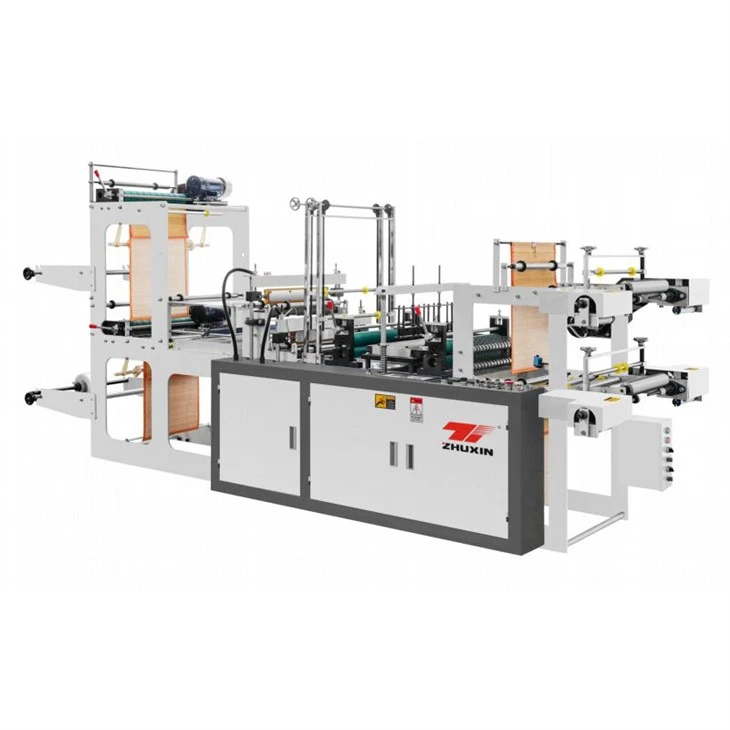
Benefit 3: Enhanced Workforce Safety and Ergonomic Protection
The benefits of new garbage bag bags are not just money. They also include significant progress in worker safety. Old machines typically require operators to manually clear blockages, manually splice new film rolls and adjust heavy sealing frames by force. These tasks can lead to repetitive strain injuries, needle-tip accidents and heat surface burns. New design has an automatic lift carriage that automaticallyreverses the line's optical jam detection before damage is caused, and a touchscreen controls that eliminates manual dial adjustments.
In its 2023 Plastics Industry Safety Survey, OSHA noted that in 36 months, factories that replaced pre-2010 bag lines with fully automated versions recorded a 58% decrease in the number of recordable workplace injuries (OSHA, 2023). For plant managers, the benefits mean higher worker morale, lower workers' comp costs and fewer downtime for accident investigation and retraining. A safety-centred garbage bag manufacturing machine is a key part of a strong environmental, health, and safety (EHS) culture.
Benefit 4: Inventory Optimization Through Rapid Size Changeover
The benefits of new garbage bag go beyond money. It also includes significant progress in worker safety. Old machines typically require operators to manually remove blockages, manually splice new film rolls and adjust heavy sealing frames by force. These tasks can lead to repetitive strain injuries, needle tip accidents and heat surface burns. New design has an automatic lift carriage that automatically reverses optical interference detection of lines before damage occurs, and a touchscreen controls that doesn't require manual dial adjustments.
In the Plastics Industry Safety Survey 2023, OSHA noted that in 36 months, factories that replaced pre-2010 bag lines with fully automated versions recorded a 58% decrease in the number of recordable workplace injuries (OSHA, 2023). For plant managers, these benefits mean higher worker morale, lower workers' comp costs and fewer accident investigation and retraining downtime. Safe garbage bag machines are an important part of a strong environment, health and safety culture.
Benefit 5: Lower Energy Consumption Per Thousand Bags
Sustainability is no longer just a marketing term. This is now a purchase requirement. Large stores and city governments often require environmental product declarations from their suppliers. One of the obvious advantages of new garbage bag machines is that they use much less energy per 1,000 bags. This is in kilowatt-hours. The transition from induction motors to permanent-magnet servo motors, coupled with the use of infrared preheater seal, has brought real efficiency gains.
A full energy audit U.S. The U.S. Department of Energy's 2025 AMO surveyed 15 bag factories in the Midwest. The audit found that regenerative brake lines (which conserve energy during deceleration) and efficient extruder drives used 0.38 kWh per 1,000 bags. Old equipment used 0.52 kWh electricity. This represents a 27% increase (DOE AMO, 2025). For a plant that operates 8,000 hours a year, that would mean annual savings of over 110,000 kWh per line. This lowers electricity costs and reduces the plant's carbon footprint.
Benefit 6: Data-Driven Quality Assurance and Traceability
One of the least recognised advantages of the new garbage bag machine is its full production traceability. Today's machines have built-in vision inspection systems. The cameras use high-speed cameras and instantly find pinholes, gels and color streaks. When a defect is found, the system can flag the section or send it to the rejected bin. This ensures that only good bags make it to the machine.
In addition, these systems record data for each batch. This includes accurate resin lot numbers, the sealing temperature profile, room humidity and operator IDs. When customers complain, this data can be useful in finding root cause. ISO food safety Management Standard 22000: 2018 lists traceability as a core requirement. This level of documentation is increasingly needed for Garbage bags used for food exposure or medical waste. garbage bag with complete data collection provide a traceability chain. This protects producers in liability cases and meets the stringent auditing requirements of large corporate buyers.
Conclusion
The advantages of a garbage bag manufacturing machine include many things. This includes quality, cost, safety, flexibility, sustainability and compliance. It would be a mistake to think of the machine as a simple purchase. It is a strategic investment that affects every aspect of production and operation. Better seal strength to keep customers happy. Stretching reduces the use of resin. Safety features protect workers. Quick changeovers allow quick responses to orders. Energy conservation reduces operating costs. Data collection provides an auditable record.
For manufacturers who see the garbage bag market as both a base market and a demand market, the new machines offer a clear way to stand out. It's not just a tool to make more bags every hour. It is a system that is better made, less wasteful, cheaper and more confident. In an industry where price pressures never stop, all these benefits add up to more than just advantages. They are necessary.
References:
ASTM International. (2023). ASTM D882-23: Standard Test Method for Tensile Properties of Thin Plastic Sheeting. West Conshohocken, PA: ASTM.
DOE Advanced Manufacturing Office (AMO). (2025). Energy Benchmarking in Plastic Film Converting: Final Report. Washington, D.C.: U.S. Department of Energy.
OSHA (Occupational Safety and Health Administration). (2023). Plastics Industry Safety Survey: Data Summary. Washington, D.C.: U.S. Department of Labor.
PMMI (Packaging Machinery Manufacturers Institute). (2024). Benchmarking Changeover Efficiency in Flexible Packaging. Herndon, VA: PMMI Business Intelligence.
SPE (Society of Plastics Engineers). (2024). Advancements in Film Draw-Down and Gauge Control. Newtown, CT: SPE Technical Publications.
TAPPI (Technical Association of the Pulp and Paper Industry). (2024). Seal Integrity in Polyethylene Films: A Comparative Study. Peachtree Corners, GA: TAPPI Press.


