


Efficiency is not just a goal in today's manufacturing world. This is a basic need for businesses to survive. For plastic waste bags manufacturers, profit or loss often depends on how well their main machines are running, from small kitchen linings to heavy industrial bags. Therefore, the question of how to improve the efficiency of the garbage bag bagging machine is not just theoretical. It asked directly if the operation would survive. The answer comes from a combination of automation, knowledge of materials and links to intelligent systems. This turns a simple extrusion-and-sealing line and sealing line into a high-yield, low-waste production system.
Automation and the Reduction of Human Error
The first and most obvious benefit of a modern Waste Bag Making Machine is that it doesn't have to be hands-on. Old wiring requires a lot of operator skills such as tension, sealing timing and cutting accuracy. Human error in these steps can lead to weak seals, size differences and many stops. According to the Plastics Industry Association's China Semi-Automatic Packaging Industry Analysis 2023, fully automated packaging machines can reduce downtime for human failure by up to 72% compared to older semi-automatic packaging machines (PLASTICS, 2023).
New machine uses servo motor systems to adjust the feed film, seal and cut very accurately. This alignment ensures that each bag is the same as the last. It stops the mechanical system from "drifting." For production managers, this means fewer rejected batches and less waste. In well-equipped systems, the scrap rate typically drops from 3-5% to under 0.5%. Therefore, the Waste Bag Making Machine becomes a tool to control the stabilization process. Mass is an intrinsic requirement of movement, not just the final test.
Speed and Throughput: The Economics of High-Speed Cycling
Production speed is the most obvious number, and the payoff here is huge. High-speed trash bag makers for standard T-shirt bags can now run more than 250 times a minute. Heavy lines treated with thicker films (50-100 microns) can maintain a steady speed of 150-180 laps per minute. It doesn't just come from faster engines. It comes from new thermalsealing technology that reduces "dwell time," the time it takes for the seal rod to press the film to bind.
A study published in the Journal of Polymer Engineering (Vol. 44, No. 2, 2024) shows that new pulsed sealing system has a stable seal strength with a 40% shorter residence time than old constant-heat system. This directly increases production without affecting the drop strength of the bag (Kumar & Singh, 2024). For a factory operating on a double shift, every 20% increase in a Waste Bag Making Machine can add more than 400 hours of production a year. This creates new capacity without having to buy an entire Tier 2 city.
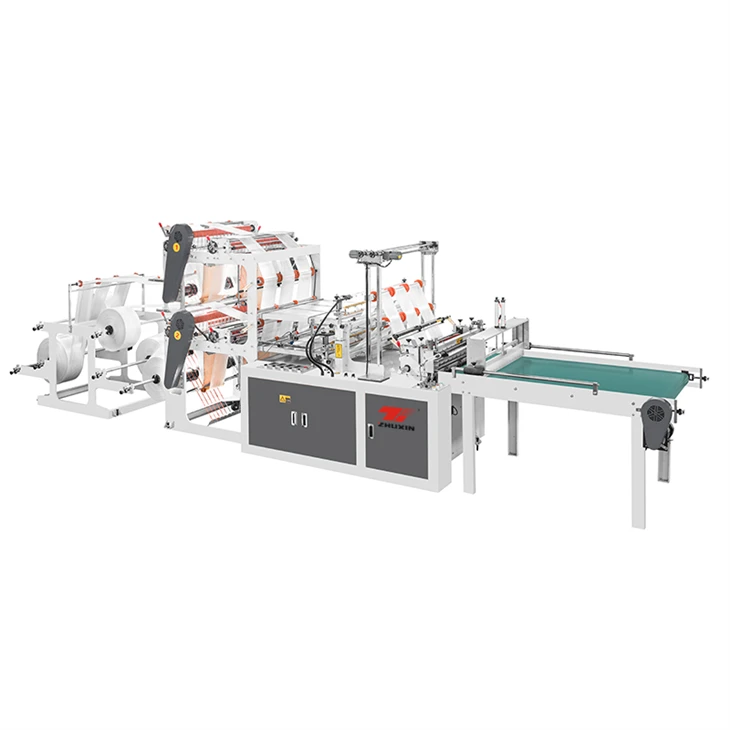
Material Efficiency and Waste Reduction
Productivity is not just how many bags you make. It's also about how much resin is wasted in production. Smart bin bags help with production by using a built-in edge-trimming recycling systems. These systems capture the web edge trims from the tangent step and blow it back into the extruder's hopper. This creates a closed loop of waste. According to the German Federation of Engineering (VDMA, 2023 Plastics Machinery Report 2023), this rapid recycling can recycle up to 98% of edge trim waste.
In addition, new machines use auto thickness gauges (usually beta or x-ray types). These provide real-time feedback to the extrusion mould. If the cross-section of the film starts to change, the pressure gauge will adjust the die gap in milliseconds. This active control stops "overweight" bags. This is a common problem, with manufacturers adding 2-3% extra material to each bag just to meet minimum thickness rules. By tightening tolerances, Waste Bag Making Machine systems can save between 1.5 and 2.5 tons of raw materials per line per year. When polymer prices are volatile, this directly boosts profits.
Changeover Flexibility and Just-in-Time Production
Today, producers must have more bag sizes, colors and film thickness than ever before. Rigid machines are a bottleneck. People who are flexible are better than others. New bin bag model now has a "formula management" system. These storage settings apply to many product types. At one point the Ibrox rematch took 45-60 minutes with a hand adjustments. Now, with touchscreen controls, it can be done in five minutes. These controls automatically move the seal head, adjust the release tension, and set cut lengths.
This flexibility allows for a shift to just-in-time production. Instead of stocking multiple bags, manufacturers can make smaller, more frequent batches based on actual orders from customers. A study by the Fraunhofer Institute for Manufacturing Engineering (2024) found that JIT-ready bag lines reduced the cost of storing finished products by an average of 34%. They also increased on-time delivery to 99.2% (Fraunhofer IPA, 2024). Therefore, the Waste Bag Making Machine is not only a processing unit, but also a tool for lean production.
Energy Consumption and Operational Cost Per Unit
To measure improvements in production, you have to look at cost of each bag, not just the number of bags per hour. Energy is usually the second most variable cost after resin. The design of the new garbage bag bagging machine has the characteristics of energy saving and directly reduces the cost of each bag. Servo motors get power only when in motion, so they are much more efficient than hydraulic or clutch braking systems that use constant power all the time. Ceramic heater bands on seals also help. They heat up faster and stay warm longer, reducing electricity use.
A full lifecycle study conducted by the Association of Plastics Recyclers in early 2025 found that new bag dusters use 22-28% less electricity per 1,000 bags compared to a decade ago (APR 2025). For a mass-production company with multiple production lines, that means more than $15,000 in yearly energy savings per machine. This lowers the overall cost of production and makes the product more competitive in the market.
I
ntegration with MES and Industry 4.0
The last and biggest long-term benefit of modern garbage bagging machines is their role as intelligent nodes in manufacturing executive systems. The machines now have OPC-UA communication protocols. This allows them to send real-time data about uptime, output count, seal temperature and power usage directly to central screen.
This data link can be maintained predictably. The system can warn operators of vibrations or heat changes before bearings fail or heaters burn out. As a result, maintenance can be done according to scheduled downtime, rather than after a sudden failure. Industry analysts at McKinsey & Company estimate that predictive maintenance in plastics processing can reduce unplanned downtime by another 30-50% (McKinsey Operations Practice, 2024). The garbage bag machine is no longer a stand-alone mechanical device. It is a data source for shift planning, raw material procurement and capital expenditure decisions.
Conclusion
To answer how garbage bag makers improve productivity, you have to go beyond simple speed comparisons. The real improvement is across the system. It comes from servo-driven accuracy reduces waste. It comes from energy-efficient designs that reduce cost per bag. It comes from allowing a quick changeover of JIT responses. It also comes from smart sensors that can predict trouble before it happens. For manufacturers, the new bin bag machine is more than just an upgrade. It is a strategic tool that applies to three main components of manufacturing success-cost, quality and delivery. This is not just an improvement in a market environment where margins are tight and customer demand is tight. This is a must.
References:
- APR (Association of Plastics Recyclers). (2025). Lifecycle Energy Use in Film Conversion: A 2025 Update. Washington, D.C.: APR Technical Publications.
- Fraunhofer Institute for Manufacturing Engineering and Automation (IPA). (2024). Lean Production in Plastics Converting: Inventory and Delivery Performance. Stuttgart: Fraunhofer IPA Report Series.
- Kumar, A., & Singh, R. (2024). "Pulse Sealing Dynamics in Polyethylene Films." Journal of Polymer Engineering, 44(2), pp. 115-128.
- McKinsey & Company Operations Practice. (2024). Predictive Maintenance in Process Industries: The Plastics Sector. New York: McKinsey Global Institute.
- PLASTICS (Plastics Industry Association). (2023). Operational Efficiency Benchmarking Report for Film & Bag Producers. Washington, D.C.: PLASTICS Publishing.
- VDMA (German Engineering Federation). (2023). Plastics Machinery: Global Market Data and Efficiency Trends. Frankfurt: VDMA Plastics and Rubber Machinery Association.


