

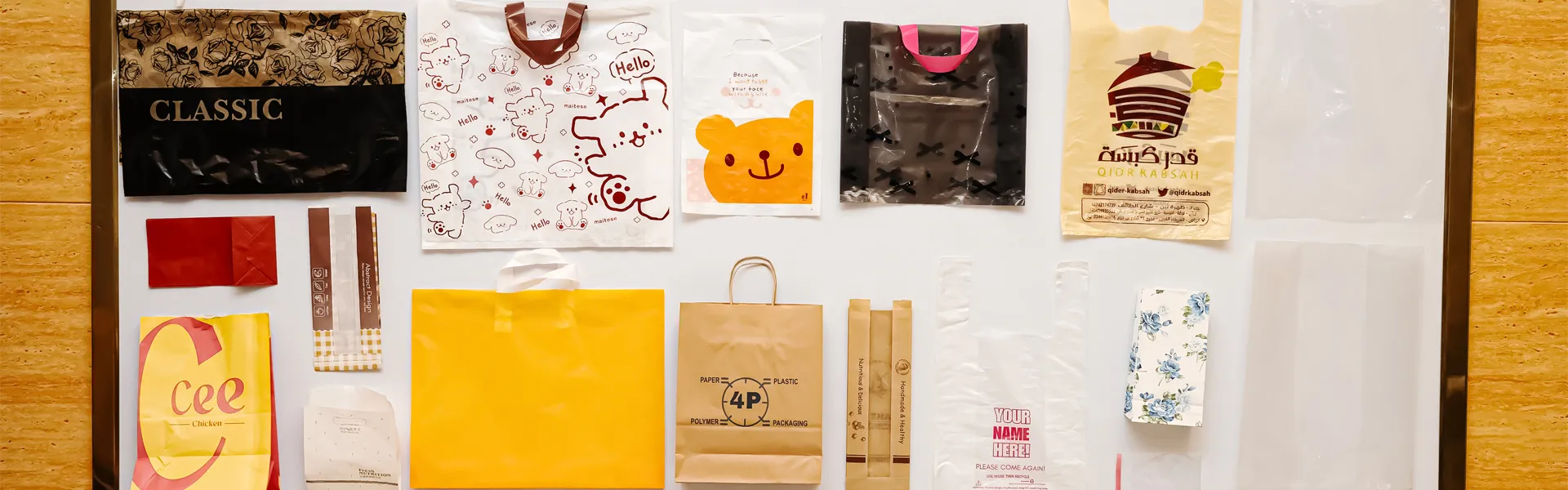
T-shirt bags are also called vest satchels. They were thin plastic bags with built-in punch handles. You can find them at grocery stores, produce areas and takeaway counters around the world. They have the name because when you put it flat on the outside handle, it looks like a sleeveless T-shirt. T-shirt bags account for about 29% of the global plastic bag market, according to market data from the Foresight Research Institute. As such, they are the most manufactured plastic bags. Manufacturers and procurement teams ask a simple question. Can a standard switching line make these bags? Or does it need a special setting? The short answer is yes. But it's only true if it's configured right. This will be explained in this article.
How a Plastic Bag Making Machine Operates
To understand the answer to this question, you need to see what plastic bag makers actually do. The machine was built after blowing out the membrane. In this line, polyethylene resin-usually a mixture of high-density polyethylene (HDPE) or high-density polyethylene (HDPE) and linear low-density polyethylene (LLDPE) -are melted down. Then blow it into foam. It then cools to a tubular film. Then wrap it around the scroll. The bag maker takes these rolls and does a series of steps. It opens the film. It can fold film if needed. Then cut it short. Then the cover. Then stack the finished bags.
A study in Applied Sciences 2023 (MDPI) by Cuesta, Camacho, and Rubio of UNED in Spain showed that the mechanical properties of HDPE/LLDPE blown film --especially tensile strength and elongation during fracture --can be well predicted in three extrusion settings. They are the explosion ratio (BUR), the absorption ratio (TUR) and thickness reduction ratio (TR). The R2 was found to be between 0.91 and 0.95 in a math relationships that controls mechanical orientation (MD) and the transverse direction (TD) tensile performance. These findings are important for T-shirt bag production. This is because the bag area is under a lot of pressure when it comes to bagging. If the film is not strong enough in any direction, the handle will fall off too soon. This is a common malfunction of poorly made waistcoat bags.
What Makes T-Shirt Bags Different from Flat Bags
Flat bags-bags for bread, produce or simple packaging-simply film unwinding, bottom sealing and cut. There are three more steps to a T-shirt bag. These steps add mechanical complexity to the conversion process.
1.The first step is to deal with punching holes. After the bag is formed, the stamping handle of the die cutting table is opened. This is the hardest step. This is because the punch must fit perfectly with the sealing edge, while the film is constantly moving. Even a half-millimeter deviation can cause the handle to be asymmetrical. It also affects weight of the bag.
2.The second step is bottom gusset formation. This is optional, but common. Many T-shirt bags have a ruffle at the bottom. It is a folding panel that opened when the bag is filled. It will make the bag bigger, not wider. Adding a gusset requires an extra folding mechanism. Such a body must work in a timely manner with the sealing station.
3.The third step is to strengthen the cover. The top hem to which the handle is attached must have a wider and stronger thermalseal than the bottom seal. This is because when you lift the bag, the seal on top holds all the weight inside. The bottom seal, 2 – 3 mm wide, is fine for flat produce bags. But T-shirt pockets typically need to be 8-12mm wide to seal. This stops tears from spreading.
4.Conversion lines set up solely for flat bags do not have these three stations. Adding them is what separates the production line that makes the bags from the production line that makes the bags.

Machine Configuration: The T-Shirt Bag Converting Line
The following steps are required to produce T-shirt bags on the conversion line.
First is a tension control release rack. The tension of the film must remain the same because the reel is smaller. Too much tension causes the handle punch to deviate from position.
Secondly, you can choose to fold inwards. This method is used if the film enters as a single sheet rather than as a pre-folded tube.
Next is the bottom sealing station. This is usually a hot-bar sealer working at 140–170°C on a HDPE film. Temperature accuracy is very important. Applied Science (2023) found that HDPE-C6 copolymer achieve almostcomplete molecular relaxation above 130°C. Seal quality plummeted below 120°C. This is because the polymer chains is not sufficiently diffused to fuse properly.
The second is the handle die-cutting table. It can be made of steel molds or a servo-driven rotary punch. Rotating presses are suitable for high-speed lines. This is because it does not require the length of stay required for reciprocating molds.
Then there are the stacking units. The men divided bags into counted stacks - usually 50 or 100 each - for retail packaging.
The key question for manufacturers is whether existing Plastic Bag Making Machine units can be upgraded with die-cutting modules and enhanced sealing heads. In many cases, the answer depends on the machine's frame length. The handle punch station and reinforced head sealing machine occupy an additional machine length of about 1.2-1.8 meters. If the existing framework was built with module expansion in mind - with pre-drilled mounting points and synchronous drive shaft extension ports - then modification is possible. However, if the frame is a compact, fixed-length design designed only for flat bags, then remodelling is impractical. And a dedicated line of T-shirt bags becomes the only viable option.
Material Requirements: Film That Holds Under Load
The pressure of the T-shirt bag on the polyethylene film is more than a flat bag can withstand. When a flat produce bag is filled with 2kg apples, the weight is evenly distributed along the bottom seal. But when a T-shirt bag is lifted, all the weight is on two narrow handle attachment points. Each point is about 15-20mm wide. So that creates a high pressure spot. At a sealing width of one millimetre, this stress can be more than 10 times the normal load.
That's why HDPE is almost universal in T-shirt bags. Applied Science (2023) found that the mechanical direction of the HDPE-C6/ HDPE-C6/LLDPE-C4 blends strength values of 25 – 35 MPa at normal production thicknesses 10 – 50 μm). LLDPE has good dart impact resistance. Similarly, The same UNED study found that the film (9.5–9.9 μm) had a dart impact value of 297–300 g. Thicker films (43–56 μm) had only 80–95 g., but LLDPE itself was not hard enough. So with a steady load, the handle can stretch too much. The bimodal molecular weight structure HDPE provides a suitable combination of stiffness and tensile strength for the bag to be carried by the handle.
The Answer: Yes, with Constraints
So, can such machines make T-shirt bags? The answer is yes. But on one important condition. This machine must be specially made for waistcoat case. Alternatively, it must be upgraded to handle the punch, strengthen the head seal and have the option of a bottom buckle station. A Plastic Bag Making Machine fitted only to a flat-pack or underpack wouldnot have been able to make a T-shirt bag without these add-ons.
The configuration restrictions mean manufacturers that serve both the bag and grocery bag markets typically operate two separate production lines. First, the high-speed flat bag production line, production of thin bags. Another is the T-shirt bag line with full punch and enhanced sealing. Another option is modular wiring, which can change quickly between configurations. However, the downtime costs of switching molds, adjusting seal temperatures and recalibrating tension must be compared to the cost of purchasing a second specialized machine. Even when a Plastic Bag Making Machine is modular, the changeover time and quality validation often push producers toward dedicated lines for high-volume T-shirt orders.
Quality Verification
Completed T-shirt bags should be tested for ASTM D882. This is a standard test method for tensile properties of thin plastic sheeting. Applicable to films less than 1.0 mm thick. Key measurements are tensile strength at fracture (in MD and TD) and elongation at fracture. The measurements came from samples cut from handle areas and bags. The length of the handle area is usually lower than the body. This is because the die-cutting process creates tiny indentations. These grooves act as stress points. Well-tuned Plastic Bag Making Machine units reduce this difference by keeping the punch blades sharp. Dull blades tore through the film, not through it. So they leave rough edges. These rough edges concentrate stress. Then, compared to a clean handle, it has a 15 – 25% lower handle strength.
Additional functional testing should include static load testing. In this test, a full bag is hung by its handle for a fixed period of time (usually 60 minutes below rated capacity). Dynamic drop testing should also be included. In this test, a full bag fell from its standard height onto a hard surface. This is done to check the strength of the seal under impact.
Conclusion
The devices can make T-shirt bags. On modern lines, it's between 100 and 250 bags a minute. But not all machines have this ability. It depends on the station setting. The machine can only produce flat bags without handle die-cutting machines and reinforced head sealing modules. With these transmissions, the same transmissions becomes a T-shirt bag line. It can make the world's most widely used plastic bag type. Understanding this difference is important for manufacturers. They need this when they look new equipment. They need it to expand production. They need this, and when they solved quality problem, lines appeared to be used beyond their original design limits. Ultimately, whether a standard Plastic Bag Making Machine can produce T-shirt bags comes down to its frame, modularity, and the presence of those three critical stations - punch, reinforced seal, and optional gusset - not just to the base extrusion or winding capability.
References
- Cuesta, F., Camacho, A.M., & Rubio, E.M. (2023). Influence of the Main Blown Film Extrusion Process Parameters on the Mechanical Properties of a High-Density Polyethylene Hexene Copolymer and Linear Low-Density Polyethylene Butene Copolymer Blend Used for Plastic Bags. Applied Sciences, 13(22), 12164. MDPI.
- ASTM International. (2021). ASTM D882-18: Standard Test Method for Tensile Properties of Thin Plastic Sheeting. ASTM International, West Conshohocken, PA.
- Future Market Insights. (2025). Plastic Bag Market: Global Market Analysis Report. T-shirt Bags segment share: 29.4%.
- United Nations Environment Programme (UNEP). (2021). Life Cycle Assessment of Beverage Cups. Life Cycle Initiative.
- Shimadzu Corporation. (2025). ASTM D882: Standard Test Method for Tensile Properties of Thin Plastic Sheeting - Test Procedure Overview. Shimadzu Scientific Instruments.


