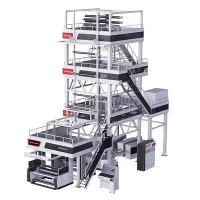

Automatic Plastic Bag Making Machine reduce labour costs by converting the number of hours of operation per million bags into a number through tasks-feeding, sealing, stacking, counting, converting and QC.
Labor is a cost on a production line of cloth bags used for every shift in a machine's life cycle, and that's where automation arguments start. However, "one operator, not three" is a requirement, not a calculation, and the first time a third operator is asked what they are actually doing, the requirement falls through. One task at a time, this paper completes the work of an Automatic Plastic Bag Making Machine, showing operator-hour locations on manual and automated lines, and converts differences into algorithms that remain valid after CFO inspection.
What tasks do machines actually take over
The handbag line is a chain of human attention. Each link that is automatically removed has a name, reason for existing, and tolerance to protect:
| Mission: | Manual line staffing | Instead, automation works |
|---|---|---|
| Line and Feed | 1 operator to monitoring roll and splicing | Automatic patchwork or long roll expansion with tension control stretching |
| Eyes on the seal | 1 operator judges seals by eye | Closed loop temperature control ± 2°C with drift alarms |
| Bag length and incision | Adjusted by Mechanics | Servo pull, ±1 mm, radar transceiver |
| Stacking and counting | 1 stacker operator | Automatic counting to ±1 bag, batch separation, conveyance |
| Reject removal | visual, intermittent | Inline fault detection stop lines from running when membrane breaks, misfeed and markers are lost |
| Transformation | 30–60 min with a mechanic | Recipe phone from HMI in under 5 minutes |
Read the form honestly: manual wiring requires two or three people on the floor plus an on-call mechanic. The automated production line requires an operator to monitor the screen, respond to alarms and change scrolls. Each task removed is also a human error pattern that is removed-the operator looking away at the wrong time creates a pile of poorlysealed bags that others must find later, usually another person who pays.
The Staffing Math per shift, per million bags
Switching tables for cash is another step, as Automatic Plastic Bag Making Machine change heads and speeds-machines at different speeds can make comparisons between shifts misleading. Stability is measured in operand-hours per million bags.
Manual operation: 30 bags per minute, two 8-hour shifts, 250 days. Production is 30 x 480 × 2 = 28,800 bags per day with 6 operators (3 per shift). That translates to about 4,800 bags per day for each of the 12 operators.
There is now an automated line: 120 bags per minute, on the same shift, with 1 operator per shift. Production 115,200 bags / day, 2 operators -57,600 bags /day. The labor productivity ratio is not 3:1, as the headcount comparison suggests; it is closer to 12:1, because automated machines also run four times faster.
This distinction is important for the budget. If a factory keeps production constant, it cuts operators. If volume grows, it absorbs growth rather than hiring at its usual ratio. Either way, the annual cost savings of switching manual lines in the first scenario would be approximately 4 operators x 250 days x 8 hours x loading hours. Based on each operator-a load cost of £7,000 per year, or £28,000 per year-then the number of mechanical hours no longer consumed by the receivership-based changeover, or the cost of night shifts where automation reduces carrying costs, as one person per shift is more easily staffed than three.
The Indirect Labor, lack of demographic tables
Direct operators are a visible cost. Three indirect costs are reduced with automation and rarely appear in the first quotation comparison:
Quality inspection and rework supervision. A easily drifting manual seal lines up the B-bag, which someone must find, isolate and dispose of. At the control line of closed-loop temperature, inline fault detection, ASTM F88-verified seals sampling rather than stacking inspection, the inspection labor essentially disappears because the process is capable and the machine automatically stops when it is not.
Training and turnover exposure. A mechanical line's output depends on operator skills: tension feel, sealing judgment, cutting alignment. Each evacuation took weeks, punctuated by sporadic surges. An automated plastic bag maker stores recipe skills, so a new operator can produce the required amount in a matter of days, and most of the paper staples are gone. Labour costs are not just wages-they are the cost of replacing those that quit.
Overseeing span. There were three operators per shift; one operator per shift provided exceptional supervision through alarm log and production counters where the machine had been logged. Factories that documented ISO 9001:2015 systems fold it into existing process records without adding any documentation.
Limits of redeployment, Utilization and claims
Two honest caveats keep the labor-cost model of the Automatic Plastic Bag Making Machine on the defensive. First, automation eliminates the task, not the last operator: someone must load the scroll, respond to the alarm, and clear the occasional jam, so no matter how automated the machine, there are about one person per shift on an artificial floor on a high-speed line. Second, there are economies of scale that make sense – one shift is less than three, and a factory that doesnot meet the excess capacity created by Fast3 simply cannot absorb the benefits. Therefore, returns should be calculated based on the number of shifts you can actually arrange for your employees and sales, not the maximum number that the machine can provide.
In fact, most planters are repurposed rather than cut: the operators released by Automatic Plastic Bag Making Machine are transferred to printing, packaging or a second machine, and labor savings manifest themselves in avoidance of hiring. It's still a saving-the cost per thousand bags appears to be lower as volume increases-but it's in the growth budget, not the payroll line item, and finance team should see it come this way.
Frequently Asked Questions
How many operators do automated bagging lines need?
Single line loading once per shift, responding to alarms, handling changeovers at HMI. An equivalent output line of two to three operators is a realistic comparison, so the immediate savings are one to two operators per shift.
Higher or lowerwage markets save more?
Markets with higher wages return more quickly because each of the eliminated operators is worth more annually, but low-wage markets still benefit by scrap reduction, training turnover costs and the ability of one person to work nights. The return month is determined by the ratio of machine price to labor cost of load.
Will automation too reduce quality control staff?
It reduces the need for layerby layer checks because closed-loop sealing and inline fault detection catch defects at source. QC switched from examining each output to auditing samples against ASTM F88 baselines-with less time to examine the same tonnage.
Source of information
ISO 22400-2 - Automation systems and integration: Key performance indicators for manufacturing operations (availability, performance, quality).
ISO 9001: 2015 -Quality management, training records and process documentation.
ASTM F88/F88M-Standard Test Method for Seal Strength of Flexible Barrier Materials.
Machinery Directive 2006/42 / EC 42 /EC-European Union safety requirements for unattended operating machinery.
ISO 13849-1 -Mechanical safety: safety-related aspects of control systems.
Grand View Research plastic bag and sack production market data.