


In the process of garbagebag production, the efficiency of production is not just the speed of the machine. A line running at 250 laps per minute can still lose 30 percent of its potential output. These losses are due to microdowntime, refusal to waste and long changeover times. The methods to improve the actual productivity of a Garbage Bag Making Machine include hardware engineering, control software and process design. To understand these methods, we need to look at the machine's top speed. We need to understand how machines eliminate specific types of losses that impair productivity.
Distinguishing Theoretical and Productive Output
The first rule of productivity analysis is that rated speed and actual output are rarely the same. The International Organization for Standardization, through ISO 22400-2 on key performance indicators for manufacturing operations, defines this gap with Overall Equipment Effectiveness, or OEE. OEE multiplies availability, performance, and quality rates. For example, a machine rated at 200 bags per minute has 12 percent downtime. It runs at 85 percent of its top speed to handle material variation. And it makes 4 percent out-of-spec product. This machine has an OEE of about 63 percent. So 37 percent of its theoretical capacity is lost.
A modern Garbage Bag Making Machine fixes each of these three loss areas with specific engineering solutions. It does not rely on the operator to watch for and reduce losses. The next sections look at how the machine cuts down each type of loss.
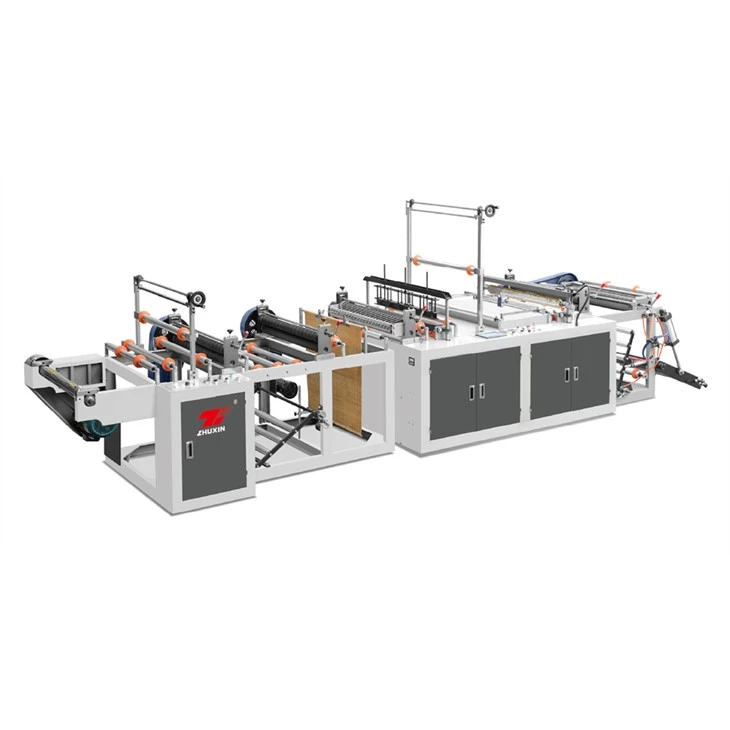
Tandem Sealing Architecture for Throughput Doubling
The most direct way to improve productivity is to change the design of the machine, not to make it run faster. Old garbagebag production line use an airtight station. Each machine at this station processes a bag. Each cycle has steps. Seals closes. Close at 160-200°C for 0.15-0.4 seconds. Then open it. The film then moves the length of a bag forward. The full cycle takes 0.4–0.6 seconds. That limits production to about 100–150 bags per minute.
In order to improve production efficiency, A Garbage Bag Making Machine adopts serial sealing device. This means alternating between two sealing stations. Station B is moving film and preparing to close when Station A was in downtime. The two stations share the same film path. But one by one they work in different bag positions. This has doubled throughput to 250–350 bags per minute. This will not halve the length of stay. This is important because a stay of less than 0.15 seconds weakens the seal.
The Society of Plastics Engineers (SPE) has a technical paper on high-speed polyethylene film sealing. The papers show that at normal seal temperatures, a residence time of less than 0.12 seconds does not allow the polymer chains to fully blend throughout the seal. This will reduce peel strength by 25–35 percent. Serial design maintains good downtime. At the same time, it doubles the number of seals generated per minute by machine time. This resulted in a 95 percent increase in net productivity over single-stop design. This increase has taken into account additional maintenance work at the second site.
Servo-Driven Film Indexing and Acceleration Profiling
Thin film propulsion mechanism pulls the film through sealing, perforating and cutting stations. The system has been a major cause of speed constraints and product variability. Mechanical cam-driven indexers has a fixed acceleration patterns. They put a towering label on the polyethylene film. Jerk is the rate of change in acceleration. This causes the membrane to stretch, change width, and sometimes break speed by more than 150 laps per minute.
Servo driven indexers replace cams with a programmable electronic cam profile. This profile is stored in the motion controller. The servo motor drives precision roller pairs. These cylinders are usually 120–150 mm diameter. They are chrome-plated and have a surface finish of Ra 0.2-0.4 microns. The roller holds the film tightly and moves forward according to the set length of the bag. They use the S-curve acceleration curve to limit jerk. The IEEE Transactions on Industrial Electronics studied this. The results show that S-curve motion profile can reduce peak film stress ratio by 40 percent compared to constant acceleration profile at the same cyclic speed. This allows the machine to operate at a rate of 250+ per minute on a 12 μm LLDPE film without exceeding the the film's elastic limit.
The servo indexer has an accuracy of ±0.3 mm for bag length positioning. This accuracy is important because variations in bag length can affect the next steps. If the paper bag is cut more than 2mm in length, the 500-bag packaging carton is too long. If the cloth bag is cut short by 2mm, the size of the cloth bag does not meet the requirements. The Converting Division of TAPPI says the dimensional repeatability was within ±0.5 mm and the volume waste rate was reduced by 60–70 percent compared to ±2 mm tolerances.
Automated Roll Changeover with Flying Splice
The change of roller is one of the biggest causes of unplanned downtime in bagging process. The standard 500kg roll is 1,200 mm wide and the 15 μm LDPE film is about 28,000 linear metres. That's enough for roughly 35,000 standard 800mm bags. At 250 bags a minute, you can run out of rolls in about 140 minutes. So there are 8-10 volume changes per shift.
Manual rewinding takes 8–15 minutes at a time. You have to stop the machine, take out the empty core, load it into a new drum, splice the tail of the film with the running wire, and rethread it. That equates to 60–120 minutes of lost production per shift. Rubbish bag makers with automatic coiling machines shorten the time of each change to 30–45 seconds. It spliced at full speed.
That's how the fly-tipping system works. The secondary unfurling position holds the replacement roll ready. Its front edge was secured with duct tape. The laser sensor detects this when the diameter of the running roller reaches the set minimum. control system then speeds up the standby roll to match line speed. It presses the hot mosaic stick against the overlap point. It clipped the old net. All this happens in 2–3 seconds. Machines never stop.
The European Association of Plastics Recycling and Recovery Organisations (EPRO) has operational benchmarking data for flexible film converters. The data shows that automated splicing system reduced average downtime per shift from roll changes 85 – 92 percent. This can restore 50-100 minutes of production time per shift.
Inline Defect Detection and Closed-Loop Correction
Quality losses is a bag made of specifications that must be thrown away or sold in a lower grade. These typically account for 3–6 percent of machine production without inline inspection. On the 250+ bags per hour high-speed rail line, a quality issue that goes unnoticed for even 90 seconds resulted in 375 bad bags.
Modern machine vision detection system has two key points.
Seal Check uses a 2,048 – 4,096 pixels high-resolution wire-scanning camera. The cameras will image the bottom seal as soon as it is made. System check seal width evenness. It finds incomplete fusion, or coldness. It also finds contamination like gel particles or dust trapped in the seal. The Association for Packaging and Processing Technologies (PMMI) said inline thermal imaging using visible light detected 98 percent of seal defects at speeds of more than 300 bags per minute.
Perforation inspection uses a second camera. The camera checks the depth and uniformity of the perforation. A puncture caused by a shallow tourniquet bag. Too deep a wound cause bags premature tear in the wrapping. The system measures the thickness of the remaining material bridge at each perforation point. It marks bags outside the 0.5 -1.5 mm tolerance range.
When a defect is detected, the system not only sounds the alarm. It sends measurement data back to the sealing and perforation controllers. If seal temperature is too low and the fusion is incomplete, the controller will automatically raise the setting point 2 – 3° C. If perforation depth is too shallow, blade depth servo adjustment 0.02 mm. This closed-loop correction is approved in accordance with Article 8.5.1 of the the ISO 9001 quality management framework on the output of the control process. It reduces quality-related waste from 3–6 percent to under 0.5 percent. This equates to an 6 – 12 extra production minutes per hour.
Quick-Change Tooling for Multi-Format Production
As the trashbag line expands, so will sizes, such as from 20-liter kitchen bags to 240-liter bin liners. Gauges also vary, from thin bags of 12 microns to 35 μm heavy-duty ones. And different styles, such as flat seal, star seal, zipper, seal, etc. Therefore, quick switching between these types is a key factor in output.
The SMED the SMED method by the The Japan Management Association. Many factories use it to switch jobs. SMED divides setup time into two parts. Internal settings means the machine had to stop. External settings mean you can be ready as the machine keeps to run. A Garbage Bag Making Machine that follow SMED rules have these features.
- Quick-release seals using cam lock lever instead of bolt cutters. As a result, the time taken to exchange barcodes has been reduced from 20 minutes to less than 3 minutes.
- Tooling carts in place in advance. They hold the next format's seal bars, perforation blades, and folding plates right in the machine. They are set up in the current run.
- Servo adjustments according to recipe. The length, folding width and perforation position of these control bags. PLC will call them in five seconds. And it doesn't need mechanical change.
- The connection points of the threaded guide rails and tape bonding stations are color codes. Therefore, the operator does not need to look at any manual to find and connect the correct path.
ISO 22400-2 OEE rules are used by the Institute of Manufacturing Performance. They found that SMED-based bag machines was able to change the entire format in six to 10 minutes. This one includes first item quality checks. But the average machine takes 30–45 minutes. For plants that 4–6 format changes per shift, you can save 90–180 minutes of working time.
Predictive Maintenance and Equipment Availability
Unplanned downtime comes from a component failure. For example, bearings get stuck, seal heaters burn out, or a perforation blade wear out. The shutdown has hurt productivity the most. Because it happens without warning. You have to find the problem before you can solve it.
The Institute of The Society of Manufacturing Engineers released some data. The unplanned downtime for the Packers took 45 to 90 minutes from outage to restart, the data showed. Diagnosis alone takes 25-40 minutes.
Predictive maintenance solves this problem. It's been checking the health of the parts. It gives a warning when a part gets worse but doesn't fail. The dos and don'ts of a a Garbage Bag Making Machine maker include:
Vibration sensors is mounted on bearing of sealing station. Acceleration sensors measure the vibration patterns of bearings. When the race-stripping of bearings begins, the vibration frequency changes obviously. The change can be detected between 200 and 400 working hours before the bearing completely breaks. This complies with ISO 10816 rules for mechanical vibration inspection. This early warning gives you time to change bearings during a scheduled maintenance stop.
Check seal heater resistance through monitoring. The seal contains an cartridge heaters. As heaters age, so does their resistance. By looking at resistance trends, you can see when heaters are nearing the end of their life. This prevents seal temperatures from malfunctioning during circulation. If such a failure occurred, it would cause hundreds of broken seals before any operator noticed.
Perforation-blade edges was also under surveillance. But in most cases, the sensor cannot be mounted directly on the blade. Instead, you measure the force required for silhouettes. This force is read from the torque feedback of the vane driven servo system. The blade dulled and the force goes up. When torque is 15 – 20 percent higher than normal, that means blades need to be replaced. So you can plan to grind it or replace it, rather than wait for the cut quality to deteriorate and then fix it.
United U.S.. The Energy Efficiency and Renewable Energy Office of the Department of Energy provides guidance on manufacturing system reliability. It says predictive maintenance of soft-packed devices can reduce unplanned downtime by 35–45 percent. They also reduce maintenance labor costs by 20–30 percent compared to passive maintenance.
Energy Management and Sustainable Productivity
Higher productivity can use more energy. This may reduce your savings. This is especially true where electricity prices are high or carbon taxes are imposed. A Garbage Bag Making Machine has the characteristics of saving energy and managing electricity consumption.
- Servo regenerative braking is one of the features. the film-indexing servo decelerates from full speed to zero in each cycle, the motor becomes a generator. It sends kinetic energy back to the DC bus. On fast machines running more than 250 cycles per minute, this recycled energy can meet 15–25 percent of the servo system's total power need.
- Seal backup control is another function. During roll changes, format changes, or short production stops, seal temperatures are maintained at 85–90 percent of the work setting point. It doesn't always come down to room temperature. The European Commission's Joint Research Centre (JRC) has a reference paper on polymer film converting. The standby mode reduces the time it takes to reheat the seal bar from 4–6 minutes to less than 60 seconds, it said. It uses 40 percent less energy than full reheating.
- Melting with on-demand adhesive is also used. For machines that use adhesive tape to make drawstring bags, the adhesive is processed in small batches of 50 – 100 grams using an on-demand hot melt system. They don't a full 5-liter tank at 170 all the time. This reduces the energy consumption of the adhesive system by 35–40 percent.
Conclusion
The efficiency of a a Garbage Bag Making Machine maker comes from a lot of things working together. These include the machine's design (such as tandem sealing), motion control (servo-driven S-curve indexing), automation (fly-shear roll changes), inline quality control (vision-based closed-loop correction), operating methods (SMED-based tooling design), maintenance planning (predictive monitoring based on vibration and torque) and energy use (regenerative braking and backup temperature control).
Each part made up for a different kind of loss. These loss types are from the OEE framework. They are usability, performance and quality. And the effects of those parts don't just add up. Multiply the two.
For example, if a machine increases each loss area by 15 percent, total productivity gain about 55 percent. Not 15 percent. This happens because when performance and quality also get better, more time is left for production.
It is This multiplying effect that makes a real productivity-engineering system different from just a faster one.
References
- ISO 22400-2:2014. Automation systems and integration - Key performance indicators (KPIs) for manufacturing operations management - Part 2: KPI definitions.
- Society of Plastics Engineers (SPE). ANTEC Conference Proceedings - Dwell Time and Seal Strength in High-Speed Polyethylene Film Sealing.
- IEEE. Transactions on Industrial Electronics - S-Curve Motion Profiles for Flexible Film Indexing.
- TAPPI Converting Division. Technical Guidelines for Dimensional Repeatability in Film Converting.
- European Association of Plastics Recycling and Recovery Organisations (EPRO). Operational Benchmarking Data for Flexible Film Converters.
- Association for Packaging and Processing Technologies (PMMI). Inline Inspection Technologies for High-Speed Packaging Lines.
- ISO 9001:2015. Quality management systems - Requirements.
- Japan Management Association. Single-Minute Exchange of Die (SMED) methodology and implementation framework.
- Manufacturing Performance Institute. OEE Benchmarking Studies for Converting Equipment.
- Society of Manufacturing Engineers (SME). Predictive Maintenance Case Studies in Flexible Packaging.
- ISO 10816. Mechanical Vibration - Evaluation of Machine Vibration by Measurements on Non-Rotating Parts.
- U.S. Department of Energy - Office of Energy Efficiency and Renewable Energy. Manufacturing Systems Reliability and Maintenance Guidance.
- European Commission Joint Research Centre (JRC). BAT Reference Document for Polymer Film Converting Industry.


