

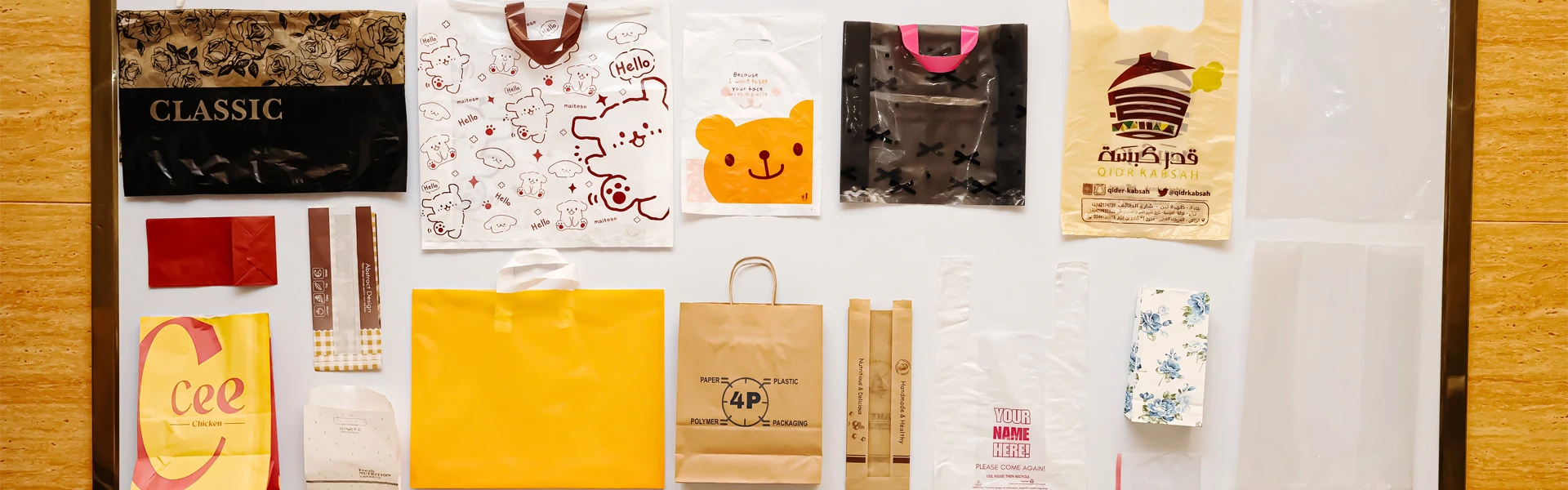
Making tote bags-whether paper, plastic or nonwoven fabric-involves a series of steps: cutting, sealing, folding and finishing. These steps convert continuously rolling raw materials into a finished bag for retail or factory use. Adding handles and installing patches is the most difficult mechanical task in these steps. The tote bag maker must move a web of several materials at once, apply glue or heat seals with great precision, and maintain a speed of more than 150 bags per minute. To understand how these machines automatically handle insertion and patches, we need to look at mechanical parts, sensor systems, and control setups that work together.
The Baseline: Bag Body Formation
Bags must be made before handles or patches are added. In a standard plastic bag maker, the film falls off a large roll, folds into a tube shape and seals at the bottom. The cutting blade slices the pipe into separate pockets at an appropriate length. Each bag then moves forward on the conveyor belt or chain system, ready for the next step.
Alignment of the bag when it reaches the handle or repair station is key to all subsequent work. If the bag falls off by 2mm or 3mm, handling or patching will continue to go wrong, making a bad bag. Alignment is achieved through mechanical guides, photoreceptors that read the imprint on the film and servo-driven transmission systems to adjust the position of the bag as it moves. these exactness needs are covered by ISO 21848. It sets size limits for flexible packaging machines.

Handle Insertion: Material Preparation and Feeding
Automatic handle insertion start with a separate supply of materials: a roll of flat material-like paper tape, plastic ribbon or cut film strips-becomes the bag handle. The handle material must be cropped to a certain length, and if a loop handle is needed, fold it up and place it in the right spot in the bag before connecting.
In a bag maker for a circular bag, the handle strip is first cut to a length suitable for the handle loop attachment tabs. The band is then folded into a U or D shape using a mechanical folding table with a guide plate and guide rail. The shape of the folds must be the same every time. The change in the fold changes the length of the handle, making it uneven. Servo-controlled folding systems have replaced cam-driven mechanical folders in newer machines. This is because the servo system allow folding sizes to be changed electronically without the need to replace parts.
Patch reinforcement-placing a small rectangle of material on the handle attachment point to spread the load and prevent the handle from tearing the bag membrane-unties a separate network of patch materials and cuts them into individual patches. Patches are usually cut using a rotary die and an anvil is used to cut the patch. This allows the same size patch to be produced at the same speed. The patch is then moved into the bag using a vacuum suction cups or mechanical fixture. These place the patch exactly above the handle attachment point.
The society of manufacturing engineers has written a paper on servo-driven material feeding systems in mechanical processes. They show that when using servo feeders for real-time tension control of the material network, alignment accuracy of ± 0.5 millimeters can be achieved at a rate of 200 laps per minute. This level of accuracy is key to patch placement. The patch must completely cover the handle attachment area to provide good reinforcement.
The Bonding Operation: Adhesive, Heat Seal, or Ultrasonic Weld
Once the handle and patch on the bag are in place, they must be secured. In tote bag making machine, there are three kinds of commonly used bonding methods. According to the packaging material, the required bond strength, production speed and other factors to select.
The application of hot melt is the most flexible method. It is suitable for gluing handles and patches to paper, non-woven cloth and some plastic bags. The heated glue tank pumps molten adhesive through a programmable nozzle. This nozzle puts a pattern of glue on the bag or on the handle label. The nozzle pattern-usually rectangular, double-wired or dotted-is controlled by a solenoid valve, which open and close as the machine circulates. The temperature and amount of glue must be appropriate. Too little glue, too weak, can break under weight. Too much glue can lead to extrusions that stain machines and cloth bag surfaces.
When the bag and handle are of the same type of thermoplastic films, use a thermal seal. Heat the seal and press the handle to the bag. This melts the plastic contact point and forms a weld. Seal settings-temperature, pressure and time-must be set for specific films. ASTM F88 provides a standard test method for measuring seal strength of flexible materials. Machine manufacturers use these tests to check seal settings in machine controller.
Ultrasonic welding is a relatively new bagging method, especially suitable for nonwoven bags. Ultrasonic speakers vibrate at 20 to 40 kHz. This creates friction heat at the point of contact between the handle tag and the bag. Local heating can be welded without extra heat or glue. Ultrasonic welding has the advantages of cleanliness, tastelessness and no thermal damage to surrounding materials. This is important for the use of food-grade bags. NIST published work on setting ultrasonic welding parameters for thermoplastic nonwoven materials. They found that weld strength was closely related to the vibration amplitude and clamping pressure. The best settings can vary widely depending on the type of polymer.
Synchronization: The Control Architecture
The main challenge with automatic handle insertion and patch processing is timing. Bags, handle materials, patch materials and bonding mechanism must all be in the same position at the same time, moving at high speed cycle after cycle, with no room for timing mistakes. This timing is done through layered control setup.
At the top, a programmable logic controller (PLC) or motion controller acts as the machine's main clock. The controller signals the main location-usually from an an encoder or virtual electronic spool on the main drive line shaft-to determine the angle of the machine's loop. Every servo motor in the machine follows this main position and calculates its motion according to the main position. When the host position indicates that the bag has reached the handle position, the handle feeding into the servo accelerates to produce the handle, the patch cuts and transfer servo to produce the patch, and the bonding system opens-all in milliseconds.
The IEEE Industrial Electronics Society has written an article on the evolution of electronic line shaft technology in conversion machines. They point out that modern distributed servo systems can control the time of an object to within ±0.1 degrees master shaft rotation. This is the same as sub-millisecond timing at normal machine speeds. This level of precision is what makes it possible to insert a fully automatic handle at a high output rate. Old mechanical systems that used cams, gears and timing belts could do this only with lots of mechanical parts and little room for change.
Sensor Feedback and Quality Assurance
Time alone is not enough. Machines must also check that each step is correct and refuse to process or patch bags that are not. Each station has a set of sensors for real-time feedback.
As the Photoelectric sensors enters the folding table, it checks whether the handle material is there and in the right place. If the sensor shows that the handle strip are missing or not aligned, the controller can trigger a malfunction and stop the machine before a bad bag forms. Visual systems-small cameras with image analysis software-are increasingly used to check the placement of patches and the shape glue pattern. The visual system takes a picture of each bag as it passes through the check point and compares it to a reference image. Bags that vary too much are marked for later shunt removal.
The FDA's HACCP framework, while originally designed for food safety, has been used by machine makers as a model for stopping defects. By inserting handle insertion and posting steps as key control points, and adding automatic detection at each step, manufacturers can demonstrate that their bag makers provide a stable, faultless output that can be traced back to set process settings
Patch Handling Variations: Reinforcement Patches and Window Patches
Patch processing in a tote bag maker works two different ways, using the same mechanical parts but in different ways. As mentioned earlier, the Reinforcement patches is located at the handle attachment point to disperse the load. Window patches-a rectangle of transparent film placed over a hole in the bag to create a transparent window-requires different positioning settings but uses the same patch feeding, cutting and bonding systems.
Being able to handle both types of patches on the same machine is a design feature of flexible portable bag maker. Patch material roll can be changed from opaque reinforcement stock to transparent window film. Cutting moulds are also interchangeable to make patches of different sizes. The controls is updated to match the size of the new patch and bonding settings. This flexibility allows one machine to produce a variety of bag bag styles without much mechanical change-a ring-shaped bag with a reinforcement patches, a die-cut bag with a window patches or a patch-only bag without.
The study by Michigan State University's Packaging Machinery Institute looked at how quickly multifunction packers move from job to job. They found that machines with servo-driven, programmable patch handling systems reduced switching times by 60 to 75%% compared to mechanically regulated systems. This reduction in changeover time directly improves machine use and reduces waste during switching between product runs.
Speed, Maintenance, and the Limits of Automation
The maximum speed of a bag carrier with an automatic handle insertion is not set by any one component. It is determined by the total time allowed by all steps in the cycle. At 150 bags per minute, the machine completes a complete cycle every 400 milliseconds. During this time, the bag must be in place, the handle must be cut and folded, the patch must be cut and moved, glue must be applied, the bonding system must be pressed and loosened, and the finished bag must be sent to the collection area. Each step uses part of a 400-millisecond budget. The rest of the time-the time between the end of one step and the beginning of the next-is a timing cushion to absorb small changes.
As speed increases, the timing cushion becomes smaller and smaller. At 200 bags per minute, the cycle time drops to 300 milliseconds. The gasket may not be sufficient to handle normal changes in material feeding, glue drying, or sensor response. Machines are more sensitive to material quality, room temperature and machine wear. Maintenance needs are more frequent and random defects are more likely.
The OMAC packaging machinery standards, created under IEEE, provides a system for machine status control and fault finding. This helps operators quickly identify and resolve timing problems. Machines that follow OMAC standards display detailed diagnostic data --including timing measurements at each site and logs that change over time. This allows for early maintenance and process fine-tuning.
Conclusion
Tote bag maker adopts servo servo-driven material feeding precision cutting and folding system, programmable programmable bonding units layered timing timing control sensor quality quality checks realize automatic handle insertion and patch processing. The machine moves several networks of materials-bags, handle bars, patches and glue-in a tight, timed loop repeated hundreds of times a minute. The shift from mechanical cam drive systems to servo-controlled, programmable setups has transformed these machines from single-use tools to flexible production platforms that can handle multiple bag styles with little changeover time. The next step is not mechanical. It's about software smarts, which improves time, predicts when maintenance should be done and adjusts when major changes occur. With advances in control systems and sensor technology, the next step will be to move forward.
References
- International Organization for Standardization. ISO 21848 - Packaging - Flexible Packaging Bag-Making Machinery - Dimensional Tolerances. Geneva: ISO, 2019.
- Society of Manufacturing Engineers. "Servo-Driven Material Feeding Systems in Converting Machinery: Registration Accuracy and Tension Control." Manufacturing Engineering Magazine, vol. 166, no. 4, 2021.
- ASTM International. ASTM F88 - Standard Test Method for Seal Strength of Flexible Barrier Materials. West Conshohocken: ASTM, 2021.
- National Institute of Standards and Technology. "Ultrasonic Welding Parameter Optimization for Thermoplastic Nonwoven Materials in Packaging Applications." NIST Technical Note 2195, 2020.
- IEEE Industrial Electronics Society. "Electronic Line Shaft Technology in Converting Machinery: Synchronization Precision and Distributed Servo Architectures." IEEE Transactions on Industrial Electronics, vol. 68, no. 7, 2021.
- Packaging Machinery Research Institute, Michigan State University. "Changeover Efficiency in Multi-Function Bag-Making Machines: Servo-Driven vs. Mechanical Systems." Journal of Packaging Technology and Science, vol. 34, no. 2, 2022.
- OMAC Packaging Working Group, Institute of Electrical and Electronics Engineers. OMAC Packaging Machinery Guidelines: State Management and Diagnostics. Piscataway: IEEE, 2020.


