

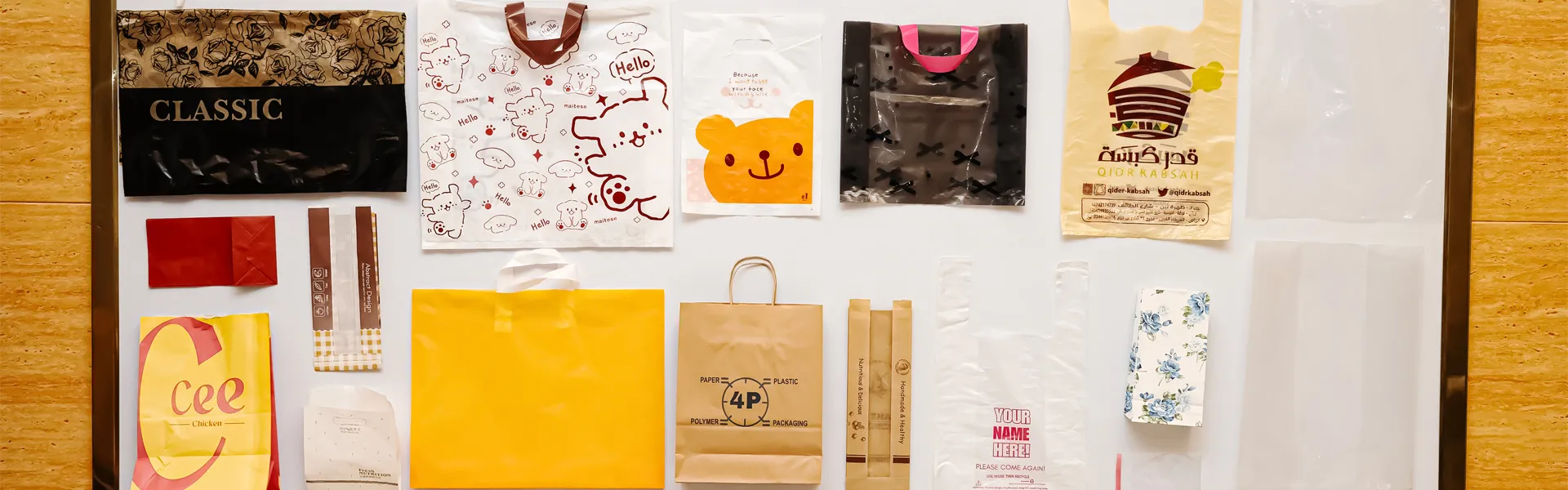
T-shirt bags-the bags carried by high-density polyethylene (HDPE) that are ubiquitous in retail, grocery and food service environments-look incredibly simple. The actual manufacturing process behind the bags' consistent mass production involves sophisticated membrane processing, synchronized thermal sealing and mechanical cutting sequences that must be performed at a coordinated pace with hundreds of cycles per minute.
The two-tier, four-wire configuration represents one of the more productive equipment architectures in the T-shirt bag industry. Understanding how this machinery functions --mechanical, hot and sequential --helps procurement managers evaluate equipment specifications, assists production engineers optimize output, and provides a structural framework for quality teams to understand the source of defects.

The Practical Significance of the "Double Layer Four Lines" Configuration
Before completing the sequence of operations, the terminology requires to be clarified because it directly affects how the machine implements its output.
Double layer refers to the membrane feed structure. Instead of running a single film network through a machine, this configuration feeds two separate film layers simultaneously through molding and sealing stations. In terms of tension control and route management, each layer is handled independently, but all pass through the same sealing and cutting stations in a coordinated time.
Four lines means that the machine produces four lines of bags at the same time on the width of the film. The film mesh is wide enough to accommodate four bags side by side. Sealing and cutting tool spans the entire width of the web and handles all four rows in each cycle.
The production math becomes clear: if the Double Layer Four Lines Automatic T-shirt Bag Making Machine runs at 200 cycles per minute and, under optimal conditions, produces four bags per cycle between two layers, effective output would be 1,600 bags per minute. Real-world figures explain the efficiency losses-film splicing, tension adjustments, maintenance intervals-but the multiplicative architecture of this configuration explains why it dominates mass-production environments.
As a result, the two-tier four-wire automatic T-shirt Bag Making Machine is essentially a parallel processing system, not simply a faster single-wire machine.
Raw Material: Film Specification and Roll Handling
The process starts with HDPE film rolls, usually 10-30 microns thick and suitable for standard T-shirt bags. The choice of Film gauge affects mechanical properties of the finished bag --tensile strength, puncture resistance and handling performance --as well as the membrane's performance during sealing and cutting.
Roll holder (unroll) can hold a film rolls in each of the two layers, usually with pneumatic braking systems, maintaining constant back tension as roll diameter is unrolled. Maintaining constant tension is critical, as HDPE films stretch under variable tension conditions, which, if not controlled, can create bags of varying sizes.
Many production-grade machines have automatic roll splicing capability. As the roll nears its end, the operator preprepares the next roll on the second holder. An automatic splicer connects the tail of the new film to the end of the depleted roll without stopping the machine to maintain continuity of production. This feature is particularly valuable in high-output configurations, where stopping and restarting the line represents significant output loss.
Step 1: Thin Film Path and Tension Management
The two thin film layers reach the forming station through a series of guide rollers and tension control systems from their respective spreading positions. The membrane path design in these machines is no accident --the location of each roller affects the way the membrane enters downstream sites.
Dance roller system uses floating rollers attached to pneumatic cylinders to automatically adjust positions to maintain preset tension levels. As the film tension increases (as happens when a nearly empty film slows down), the dance roller moves to compensate. When tension decreases, it adjusts in the opposite direction. This continuous mechanical feedback loop keeps tension within a small range, allowing for consistent sealing and cutting.
Edge guide system tracks the position of the film horizontally to correct drift that would otherwise result in the gradual alignment of the four bag lines relative to sealing tool. Photoelectric sensors detects the edge position of the film and triggers a small lateral adjustment of the film path before misalignment accumulates to a level that affects the quality of the product.
The two film layers converge at the forming station in a matching registration pattern --they must overlap precisely so that the sealing bag has a consistent alignment of layers throughout the process.
Step 2: Plastic bag shape
T-shirt bags require special geometry: the main body, handle cut at the top and bottom seal to close the base of the bag. The molding station is geometrically prepared before sealing.
For T-shirt bags sealed at the bottom, the film tube (the manufacturer folds HDPE) transforms in the machine and folds to create the bottom of the bag. The structure doesn't require a bottom seal-the manufacturer's fold will do the trick. The machine focuses on creating individual bags that handle geometry and seals, separated from a continuous network.
Handle punch or die cutting station creates a feature curved handle cut into the top of the bag. Tool design determines handle shape and the tool must match a specific bag specification. On a four-wire machine, four handle punch positions operate simultaneously, spaced to match the width of the bag.
Precise punch registration associated with the sealing position determines whether the handle is in the correct position on finished bags. Mismatch between stamping station and sealing station is a common source of defects in high-speed production --if the handle is too close to the seal line, the handle will be weak, and too much offset will create waste.
Step 3: Heat Sealing-Key Process
Heat sealing is the process step that most directly determines the structural integrity and production speed ceiling of the cloth bag. The sealing station create the transverse seals that separate the bags through a continuous membrane mesh.
The Double Layer Four Lines Automatic T-shirt Bag Making Machine uses seals spanning the entire width of the film while touching all four wire bags. Sealing bars contain embedded electrical heating elements that maintain programmed temperature points, usually between 120 ° C and 180°C, depending on the type and thickness of the film.
Seal sequence in timed cycles:
Sealer closure-The upper and lower sealing bars hold the film simultaneously while heated and pressurized. Contact pressure determines the efficiency of heat transfer to the membrane.
Staycations-The rods remain closed for a programmed period of time to allow sufficient heat penetration to melt and fuse the film layers. Dwell time is a key parameter: too short a time can lead to a weak seal that is not fully fused; too long a time can degrade film in the seal zone.
Cooling-Some configurations incorporate cooling pressure bars, followed by heated seal bars that quench the seal zone under pressure. This step improves the consistency of the seal and prevents the newly formed film from twisting forward.
Bar chart opens-the bar chart zooms back and the film indexes for the next cycle goes forward.
Temperature uniformity of the width of the whole rod is the key to ensure the consistency of the quality of the four-wire seal. Uneven temperature distribution-common in frayed or poorly maintained heating elements-creates pipes where some bags are well sealed while others are poorly sealed or open. The thermocouple is embedded along multiple points of the seal to enable control system to detect and compensate for temperature variation.
Step 4: Cut and Pack
As the seal forms, the membrane network contains a series of continuous connecting bags that must be broken down into individual units. Cutting occurs at or near the sealing line using one of two main methods:
Heat blade is used to cut the film in the seal zone at the same time as sealing. This integrated approach is faster, but requires careful temperature calibration --cutting elements must be hot enough to cut cleanly without melting adjacent materials or degrading seal edges.
Cold knife is cut with a mechanical blade, sealed and then cuts at another location. This separation of sealing and cutting allows each function to be optimized independently, usually resulting in cleaner cut edges, but requires more additional machine length and coordination between stations.
On a four-wire machine tool, cutting tool can cut across the entire web width at once, while separating all four lines. Cut registration relative to the seal line determines whether the bag has proper perforation spacing spacing in retail dispensing system.
Step 5: Roll Packs perforation
Many T-shirt bag applications require bags between units, allowing one-time distribution at retail or food service points for perforated roller delivery. In this configuration, the machine does not completely separate individual bags --instead, a perforation station forms a tear line between each bag, and the cobwebs are continuous.
Perforating rollers or perforating rod prints a series of small, closely spaced incisions on the film width at each pocket. Perforation geometry-the length of the cut, the clearance, spacing pattern-determines how easy it is to separate and whether the bag is torn cleanly or irregularly at the distributor.
After drilling, the bag wound around core tubes. Winding tension must be consistent to produce uniformly dense reels-loose reels can focus or clog the reel binoculars in the dispenser, while overly tight reels can make it difficult to separate individual bags.
Step 6: Output Counting, Stacking and Packaging
For paperback T-shirt bags (non-roll configurations), output system counts bags as they exit the cutting station and accumulates them into a pre-set quantity. Calculation accuracy is related to downstream packing efficiency --incorrect calculations can cause problems for retail packaging and inventory management.
The stacking system uses blades, air jets or mechanical guides to keep bags in the stack consistent. Properly aligned stackers pack more efficiently and can automatically feed materials to packing stations without clogging up.
Compression and bundling stations are wrapped in film or bundling material in a pile to form a the finished packs that enters shipping cartons. Some configurations integrate carton packaging automation, counting stacks and putting them in shipping boxes without manual processing.
Control Systems: coordination of all stations
Only when all stations operate at precisely coordinated times will this sequence of operations yield consistent results. Double Layer Four Lines Automatic T-shirt Bag Making Machine adopts PLC control structure and manages film index timing, sealing cycle timing, cutting registration and output system speed as an integrated system.
Index length is programmed to set the film's forward distance per cycle, which determines the length of the bag. Servo-driven film advance systems maintain index length accuracy of ±0.5mm in continuous high-speed production --critical for size consistency.
Recipe storage allows for quick switching between bag specifications. Stored parameters for bag length, seal temperature, downtime, cut registration and output count can be recalled by the operator in minutes, reducing the mechanical adjustment time for switching that has dominated the older equipment generations.
Fault detection and line stops prevent defects from spreading. Sensors that monitor film tension, seal temperature, cut registration, and output count trigger the control line to stop when parameters exceed program tolerances. When problems in development are detected, stop the production line as soon as possible to prevent cumulative defect output that requires manual inspection and rejection.
Why a two-tiered four-tier Architecture is vital for high-volume operations
The efficiency advantage of this configuration over single-line machines is not simply additive. Running four lines at once means sealing and cutting tools-the most expensive components-provide four times the output of each machine. The cost of capital per unit of capacity fell sharply.
Maintenance cycles are also larger. Replacing a heating element replacement on a four-wire machine can restore all output on all four lines, while achieving equivalent output on four separate single-wire machines requires four separate maintenance events.
The two-tier architecture adds an additional output multiplier without increasing machine footprint or operator requirements. An operator oversees eight simultaneous bagging lines in a space footprint the size of two single-wire machines.
Quality Variables that production teams should monitor
Understand that the sequence of actions leads directly to where quality control resources should be concentrated.
Consistency of four-wire seal strength is the most important quality index. Seals can cause temperature variation on the left and right sides of the machine-common after extended periods of operation without maintenance-and can cause variations in seal strength between bagged lines that are invisible during production but can cause field failures.
The registration of the handling punch relative to the sealing position needs to be verified periodically, especially after film roll is replaced, the tension transitions can shift film position slightly before the tension control system stabilizes.
Perforation quality of the volume configuration directly affects end-user experience. The perforation is too strong to prevent easy bag separation and too weak to cause the bag to tear the distributor in the middle. Periodic pull-force testing of perforation samples provide objective data for process control.
Double Layer Four Lines Automatic T-shirt Bag Making Machine high output, even a small percentage of defects can produce a significant absolute defect quantities. Consistent process monitoring can prevent quality excursions from accumulating undetected.
Conclusion:
The double-layer, four-wire T-shirt bag machine operates in a precise, timed cycle repeated hundreds of times a minute, from film opening to tension management, handle shaping, heat sealing, cutting, perforation and output. Each step builds on the previous, and any disruption at any stage spreads to all downstream operations.
For manufacturers evaluating equipment, understanding this sequence raises more pertinent specification questions: What tension control method do machines use? How does the control system handle splice transitions? What are the uniform seal temperature specifications for the full bar width? These problems mask differences between different device options, which are masked by generic rate comparisons.
For production teams already operating this equipment, the step-by-step framework on the map above illustrates the process of variation entry, making it a practical diagnostic tool for quality investigations and improvement of procedures.
Reference
Plastics Industry Association. Film & Bag Industry Technical Guide: Equipment Selection and Process Optimization. PLASTICS, 2023.
Society of Plastics Engineers (SPE). "Thermal sealing Fundamentals of Flexible Packaging Films." SPE Flexible Packaging Conference Proceedings, 2022.
ASTM International. Standard Test Method for Seal Strength of Flexible Barrier Materials. ASTM F88/F88M-21, 2021.
Association of Plastic Recyclers association. Plastic Recyclability Design Guide: Films and Flexible Packaging. APR Technical Guidance, 2023.
Packaging Technology and Science (Journal). "Thermal seal variation coefficient and its effect on Bond Integrity of Polyethylene Films." Packaging Technology and Science, vol. 36, No. 4, 2023, pp. 211-228.


