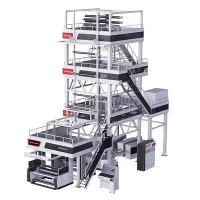
In the manufacturing process of the film blowing machine, the wrinkles of the film are a very common and challenging problem. Wrinkles not only affect the flatness and glossiness of the film itself, but more importantly, they will cause gaps between the film layer and the substrate, causing the film to break. This problem will not only cause significant damage to the appearance of the film, but may also have many adverse effects on the subsequent processing and use performance of the product. Especially in the food packaging industry, the film wrinkles are more serious due to the certain thickness and high hardness of the product. In the packaging industry, the appearance of the packaging is seriously affected by the appearance of wrinkles, which makes it impossible to perfectly display the product, thereby reducing its appeal in the market. Therefore, in order to ensure the integrity and use value of the finished packaging, it is necessary to attach great importance to the causes of film wrinkles and their solutions. For those packages that have extremely high requirements for sealing performance, such as food and medicine packaging, the wrinkles of the film may cause loose sealing, thereby increasing the risk of external contamination of the product, shortening the shelf life of the product, and adversely affecting the quality and safety of the product. Therefore, how to avoid or reduce the film wrinkles has become one of the key issues that need to be solved in the current film blowing industry. Therefore, in-depth research and effective solutions to the problem of film wrinkles are extremely important for improving the production quality of film blowing machines, increasing the competitiveness of enterprises in the market, and ensuring the economic benefits of enterprises. To this end, it is necessary to analyze the main causes and solutions for film wrinkles. This article will explore the causes of film wrinkles from multiple core angles and provide practical solutions
The problem of matching traction speed and extrusion speed
The impact of speed mismatch on wrinkles
1. When the traction speed greatly exceeds the extrusion speed, the film may be subjected to excessive tensile pressure. At this time, the film ruptures or tears due to insufficient traction. Such excessive stretching will cause uneven tensile strength in various parts of the film, resulting in inconsistent thickness. In addition, due to excessive tensile force, some materials will also have defects such as cracks or pores. In those relatively thin weak areas, it is difficult for the film to withstand excessive tensile pressure, so wrinkles are prone to occur. At the same time, too low or too high traction speeds can easily cause cracks inside the film. For example, in the process of manufacturing a polyethylene film with a thickness of 0.05 mm, if the pulling speed is set too fast, some parts of the film may become thinner to 0.03 mm or thinner, which may cause a large number of wrinkles due to its insufficient strength.
2. If the pulling speed is too slow, the extruded film cannot be pulled away in time and may accumulate near the die head. Due to the friction between the film and the die during extrusion, the film is easy to fall off from the die during the extrusion process, resulting in film waste. Film accumulation may cause a high concentration of local stress, and the extrusion force and friction force in each area will be different, which may cause wrinkles. In addition, the film surface is easily uneven due to the slow pulling speed. Taking the manufacture of a film with a width of 1 meter as an example, if the pulling speed is too slow, the length of the accumulated film per minute may exceed 0.5 meters, so that a large amount of film accumulation will inevitably lead to serious wrinkle problems.
Methods for precise adjustment of speed synchronization
1. Installation of speed monitoring device: By using encoders and other advanced equipment, the pulling and extrusion speeds can be monitored in real time and accurately. When an abnormal state occurs during the traction or extrusion process, the system will issue an audible and visual alarm message and start the corresponding functional circuit to ensure safe production. The encoder is connected to the motor shaft and has the ability to convert the motor's rotational motion into a pulse signal. By accurately counting and analyzing these pulse signals, we can accurately calculate the motor speed, thereby further determining the traction and extrusion speeds. When the traction and extrusion speeds deviate, an alarm signal will automatically be issued to prompt the staff to handle it in time to ensure safe and smooth production. This real-time monitoring method allows operators to understand speed changes at any time. Once speed deviations are detected, they can quickly adopt corresponding adjustment measures, thereby greatly enhancing the timeliness and accuracy of speed adjustment.
2. This is a control system based on a feedback mechanism. It uses advanced control systems such as PLC (programmable logic controller) to automatically adjust the motor speed according to the speed deviation information provided by the speed monitoring device. The traction force and torque generated by the traction motor during operation are detected to determine whether the motor is in a normal state. When the PLC receives a signal that the traction speed and the extrusion speed do not match, it will output the corresponding control instructions according to the pre-set program, adjust the driving current or voltage of the motor, thereby changing the motor speed and achieving precise synchronization of the traction speed and the extrusion speed. Through this method, the relationship between the traction and extrusion speeds can be accurately calculated. This automated control strategy not only effectively improves the production efficiency, but also significantly reduces the speed adjustment error caused by human factors.
Manual adjustment method: When the equipment is just started, the operator can gradually achieve speed matching by fine-tuning the motor frequency. When the equipment fails or an abnormal situation occurs, the motor frequency can be adjusted according to actual needs to ensure the normal operation of the film. In the specific operation process, the motor frequency needs to be set to a relatively low starting value first, then the relevant equipment is started, and the working condition of the film is carefully checked. If the film is observed to be stretched or piled up, the motor frequency will be adjusted accordingly. If there is no obvious abnormality at this time, it means that the process is normal. For example, if the film is observed to be slightly stretched, the motor frequency can be reduced by 0.5 Hz each time, and then the state of the film can be rechecked. This adjustment is repeated until the film can run smoothly and evenly to achieve the ideal state of speed matching.
Optimization of air ring cooling system
Mechanism of wrinkles caused by uneven cooling
- During the film blowing process, if the cooling air flow rate of some parts of the air ring is too large or the temperature is too low, the film may cool rapidly in these areas. Due to the temperature gradient and friction between the film and the air ring, bulging is easy to occur on the film blowing machine. In the area of rapid cooling, the film shrinks relatively more, while in the adjacent area with slower cooling, the shrinkage is relatively small, which will cause a significant tension difference inside the film. This causes a certain tensile stress in the film, which causes tensile deformation on the surface of the film. If this tension difference exceeds the carrying capacity of the film, it may form wrinkles. Therefore, in order to prevent wrinkles, the cooling air must be controlled and adjusted to keep the film blowing machine running stably. For example, in the process of manufacturing a 0.08 mm thick polypropylene film, if the cooling air temperature on one side of the air ring is 5°C lower than the other side, this may cause the film to form obvious wrinkles on that side.
- When the cooling air flow rate in some areas of the air ring is insufficient or the temperature is too high, the cooling rate of the film in these areas will slow down, which is the opposite of local excessive cooling. Therefore, when the cooling wind speed is greater than a certain value, "white spots" will appear on the surface of the film, that is, there are a large number of cracks and micro-voids on the surface layer of the film. In the area with a slower cooling speed, the crystallization process of the film molecular chain is more fully manifested, resulting in a corresponding increase in the thickness of the film. Therefore, in the actual stretch forming process, the film quality and processing accuracy can be guaranteed by controlling the cooling speed. In the subsequent traction operation, due to the difference in thickness of each part of the film, the traction force is also different, and the thicker part is subjected to greater force, which may cause wrinkles due to uneven force. Therefore, during the entire traction process, special attention should be paid to the temperature difference changes in each part to avoid deformation. For example, in the process of manufacturing a film with a width of 1.5 meters, if the central area of the wind ring is not cooled sufficiently, so that the film thickness in this area is 0.02 mm higher than that on both sides, then in the traction stage, this central area is very likely to produce wrinkles.
Measures to optimize the wind ring cooling system
1. Optimization of the wind ring structure: By adopting a multi-layer wind ring design, the uniform distribution of cooling air can be significantly improved. One or more layers of air curtain devices are set near the film surface to improve the heat exchange capacity between the cooling air and the film. The multi-layer air ring can achieve a more uniform cooling air blowing to the surface of the film through the interaction and adjustment of the air flow between the layers. Therefore, the cooling effect is improved to a certain extent. In addition, we have carefully optimized the air outlet design, such as adjusting the shape, size and layout density of the air outlet, so that the flow rate and direction of the cooling air can be accurately adjusted according to the specific needs of each part of the film for cooling air. In addition, factors such as film thickness and material properties need to be considered in practical applications to achieve the best cooling effect. For example, when processing the edge area of the film, we can consider increasing the number and size of the air outlet, which can increase the cooling air volume and ensure more uniform cooling of the edge and central areas.
2. When adjusting the parameters of the cooling medium, it is very important to reasonably adjust the temperature and air volume of the cooling air according to actual factors such as the thickness of the film and the characteristics of the raw materials. For thinner film materials, due to their faster heat dissipation rate, relatively low temperature and small air volume cooling air are required to prevent excessive cooling from causing film rupture. For thicker films, cooling air with higher temperature and larger air volume is required to ensure that the film can be fully cooled. In addition, the thermal properties of different types of materials are very different, so the temperature and flow rate of cooling air should be different. In addition, the requirements of various raw materials for cooling environment are also different. Therefore, when designing film cooling air, the impact of raw materials on cooling conditions should be fully considered to determine the optimal process parameters. For example, the air temperature of polyethylene film during cooling can usually be maintained in the range of 15-25°C, and the air volume can be adjusted in the range of 500-1500 cubic meters/hour according to the thickness of the film; the cooling air temperature of film made of polypropylene as raw material can be moderately increased to 20-30°C, and the air volume also needs to be appropriately adjusted.
3. Periodic maintenance and care: Regularly removing impurities in the air ring is a key step to ensure the stable operation of the cooling system. Several fans are installed on the air ring, which generate a lot of heat during operation. As production activities continue to advance, impurities such as dust and raw material fragments will gradually accumulate inside the wind ring. These impurities may hinder the normal flow of cooling air, thereby adversely affecting the cooling efficiency. Therefore, at work, the fan should be regularly inspected and cleaned according to the actual situation. At the same time, we need to regularly check the performance of the fan, including the rotation speed of the fan and the output of the air volume. If the fan stops during operation, it means that there is a problem with the fan and it should be dealt with in time. If the fan speed is observed to be reduced or the air volume is insufficient, this may be caused by factors such as wear of the fan blades or failure of the motor, so it needs to be repaired or replaced as soon as possible. In addition, in order to ensure that the film grows stably at a higher temperature, necessary maintenance and maintenance must be carried out on it. Through periodic maintenance and maintenance, it can be ensured that the cooling system is always kept in a good operating state, thereby providing a strong guarantee for the uniform cooling of the film.
Troubleshooting and solutions for die discharge problems
The process of uneven discharge causing wrinkles
1. Due to the uneven discharge of the die, the thickness of the film may be uneven. Therefore, a certain temperature must be maintained when cooling the film. During the traction and winding of the film, the traction and friction forces of films of different thicknesses will be different. As the roller speed increases, the tension also increases. Thicker areas will be subject to greater traction due to their larger mass, while thinner areas are more susceptible to excessive stretching. At the same time, factors such as friction between the film and the roller and film surface tension cause differences in the magnitude and direction of the forces they are subjected to. Such force differences may cause the film to deform during operation, and when this deformation accumulates to a certain level, it may form wrinkles. Wrinkles have a great impact on product quality. For example, when manufacturing a film with a nominal value of 0.1 mm, if the discharge of the mold is uneven, causing the thickness of the film to fluctuate within the range of 0.08-0.12 mm, then in the subsequent processing, wrinkles are likely to appear in areas with large thickness differences.
2. Non-uniformity of transverse stress: The uneven discharge of the die head will also affect the stress distribution of the film in the transverse direction. When the feed amount remains unchanged, as the film thickness increases, the pressure difference between the corresponding areas on both sides gradually increases, and at this time, the extrusion force on the film at this position is the smallest. When more material is discharged from one side of the mold and less material is discharged from the other side, the degree of extrusion and stretching of the film molecules on the side with more material discharged during the extrusion process will be different from that on the side with less material discharged, resulting in a stress difference in the transverse direction of the film. When a certain amount of film material is discharged from both sides at the same time, due to the uneven pressure on both sides, a large transverse stress will also be generated in the same plane. In the subsequent cooling, pulling and winding stages of the film, this transverse stress difference may cause the film to deform and twist, thereby forming wrinkles. Therefore, the effect of transverse stress difference on film performance needs to be considered when designing the die head. For example, when manufacturing a film with a width of 2 meters, if the discharge amount on the left side of the die head is 10% more than that on the right side, the film will have obvious wrinkles in the transverse direction due to the difference in stress.
Troubleshooting and solving die discharge problems
1. When inspecting the die flow channel, be sure to carefully observe the flow channel inside the die to determine whether there are potential problems such as wear or blockage. If there are obvious signs of damage, it can be replaced or reprocessed. After long-term use, the die flow channel may be worn due to the impact and friction of the material. These wear areas may cause obstruction of material flow and uneven discharge. In addition, since the flow channel is connected to the outside world, it is easily eroded by foreign substances, resulting in rust or other defects. In addition, impurities and gels inside the material may accumulate in the flow channel, causing blockage. Therefore, the flow channel should be checked regularly during daily production, and defects should be promptly eliminated and repaired or replaced when found. For those severely worn flow channels, we can restore them to a smooth and flat state through various means such as grinding and repair; for undamaged flow channels, the strength of the flow channel can be enhanced by adding filling materials or adding support structures to extend the service life. For those blocked flow channels, we need to use specific tools to clean them, such as flushing with a high-pressure water gun or dissolving with chemical cleaners. After the cleaning work is completed, the flow channel needs to be rechecked to ensure that there are no impurities left and that the material can flow smoothly.
2. Control the temperature of the die: Ensuring that the temperature of each area of the die is balanced is an important factor in ensuring uniform discharge. The higher the temperature of the die, the better the cooling effect on the material, but it also means that the material is heated unevenly. When the temperature distribution of the die is uneven, the flow characteristics of the material in each area will be different; in places with higher temperatures, the material has better fluidity and the discharge speed is faster; in areas with low temperatures, on the contrary, the discharge speed is slow. In places with low temperatures, the material has poor fluidity and the discharge speed is relatively slow. In order to improve discharge efficiency and reduce energy consumption, the temperature of the die needs to be accurately controlled. By installing multiple temperature sensors on the die head, the temperature of each area can be monitored in real time, and the temperature can be accurately adjusted using heating or cooling equipment. When the temperature in a certain area is too low, the system automatically adjusts the heating or cooling power of the area so that the temperature of the entire area is within the specified range. For example, if it is observed that the temperature of a certain part of the die is low, then you can consider appropriately increasing the heating capacity of this area; if the temperature of a certain area is high, you can choose air cooling or water cooling to reduce the temperature to ensure that the temperature of each part of the die is within the predetermined range, so as to ensure that the material can flow out evenly.
3. Plasticization quality of materials: It is very critical to check the plasticization level of materials. Due to different reasons for poor plasticization, the impact on production is also different. When materials with poor plasticization enter the die, there may be incompletely melted particles or lumps inside the die. These incompletely plasticized parts may hinder the uniform flow of materials in the die, resulting in uneven discharge. In addition, due to incomplete plasticization, the product will also be layered, resulting in appearance defects and performance degradation of the finished product. In order to improve the plasticization quality of the material, we can adjust key parameters such as the speed and temperature of the screw. Moderately increasing the speed of the screw can improve the shear mixing effect of the material, thereby promoting the plasticization process; on this basis, we appropriately adjust the temperature of each part of the screw according to the characteristics of the material to ensure that the material is fully melted and plasticized inside the screw. For different materials, there are optimal values for the optimal screw speed and the maximum temperature of each part of the screw. For example, when processing some materials that are difficult to plasticize, the temperature of the front section of the screw can be appropriately increased while the temperature of the rear section can be reduced to better optimize the plasticizing process.
Raw material characteristics and process adjustment
The influence of raw material characteristics on wrinkles
1. Poor fluidity performance: The flow characteristics of the raw material directly determine whether its flow inside the mold is uniform. Generally, in the blow molding process, the fluidity of the raw material is one of the important indicators to measure the quality of the product. In the case of poor raw material fluidity, the material flow rate in the die flow channel will be uneven, which may lead to uneven discharge and further trigger the wrinkling of the film. In addition, due to the different properties of the raw materials themselves, collisions and frictions between the raw materials often occur during production, which will cause the film to deform and cause wrinkles. For example, if some raw materials contain a large amount of fillers, their fluidity will be relatively poor, which makes it easier to produce wrinkles during the film blowing process. In addition, the addition of fillers increases the viscosity of the material, thereby reducing the sensitivity of the material to the molding pressure and the working capacity of the mold. The addition of fillers will cause the viscosity of the material to increase, which will hinder the smooth flow of the material, making it difficult to achieve uniform control of the thickness of the film.
2. Unsuitable tensile properties: The tensile properties of the raw materials are closely related to the performance of the film in the stretching stage. If the tensile strength of the raw material is insufficient or the stretching rate is too high, the film will break and the product will be scrapped. When the tensile properties of the raw material are not up to standard, the film may be stretched excessively or unevenly in the process of being stretched and expanded, which may lead to the formation of wrinkles. This phenomenon can be avoided by stretching the film made of polypropylene raw materials. On the contrary, if the tensile properties of the raw material are too high, the film may form wrinkles due to shrinkage during the winding process. In addition, in the production and processing of the film, improper tension control may also cause the material to deform, thereby causing wrinkles. For example, for some high-strength polyethylene raw materials, they have strong tensile properties, so during the winding process, special attention should be paid to the control of tension to avoid wrinkles due to shrinkage of the film.
Methods for adjusting the process according to the characteristics of raw materials
1. When selecting raw materials, materials with appropriate fluidity and tensile properties should be selected according to the different application scenarios of the film. In the processing technology, raw materials with a large wax content, such as polyvinyl acetate, should be avoided. For packaging films that require high transparency and excellent flexibility, materials with strong fluidity and suitable tensile capacity, such as linear low-density polyethylene, can be selected. For those industrial films that require high strength and puncture resistance, raw materials with appropriate fillers and strong tensile properties can be selected. In addition, special products should also use specific types of raw materials to ensure their use effect. In the process of selecting raw materials, we also need to consider multiple factors such as the reputation of the supplier and the quality stability of the product to ensure that the performance of the raw materials meets the production standards.
2. Adjustment of process parameters: According to different raw materials, appropriate adjustments should be made to process parameters such as temperature, pressure, and blow-up ratio. For raw materials with poor fluidity, we can consider appropriately increasing the processing temperature, reducing the viscosity of the melt, and optimizing the flow characteristics of the material. For raw materials with low crystallinity or poor crystallinity, the melt temperature and stirring rate should be controlled to ensure that the grain size distribution inside the product is consistent. In addition, increasing the back pressure of the screw can make the material subject to a stronger shear effect inside the screw, thereby further promoting the plasticization process and the uniformity of the flow. In addition, the screw speed and pitch should be reasonably selected to achieve a good plasticizing effect. For materials with high tensile properties, we can appropriately reduce the blow-up ratio, which can reduce the degree of stretching of the film during the blowing process, thereby avoiding wrinkles due to excessive stretching. In addition, different extrusion expansion rates can be used to adjust different types of plastics. Taking polypropylene as an example, its processing temperature is usually 20-30°C higher than that of polyethylene, and its blow-up ratio can be maintained in the range of 2-3.
3. Adding additives: By using additives reasonably, the processing performance of raw materials can be significantly improved, and it helps to reduce the wrinkling of the film. For example, adding lubricants before extrusion can reduce the unevenness of film thickness and increase the transparency and gloss of the product. For example, adding an appropriate amount of lubricant can help reduce the friction between the material and the mold flow channel, thereby improving the balance of material flow; by adding plasticizers, the softness and tensile properties of the raw materials can be improved, so that the film performs more evenly during the stretching process. In addition, additives can also improve the surface finish of the film and increase the appearance quality of the product. However, in the process of applying additives, the amount of additives must be strictly monitored to prevent excessive use of additives from having adverse effects on other properties of the film. In addition, in order to ensure that the impact of factors such as film quality and molding process conditions on the product does not exceed the allowable range, the rationality of the type and amount of additives must also be considered. Under normal circumstances, the amount of lubricant added should be controlled within the range of 0.1%-0.5%, while the amount of plasticizer added should be adjusted within the range of 5%-20% according to the performance requirements of the raw materials and the film.
Stable problem of winding tension
Reasons for wrinkles caused by unstable tension
1. Too high tension: When the tension during winding is too large, the film may be overstretched. Excessive winding tension is not only likely to increase the friction between the film roll and the reel, but also cause the roll to deform. During the winding process, if the film is overstretched, it will produce tensile stress on the core, and as the number of winding layers increases, this tensile stress will gradually accumulate. When the tensile strain of the film reaches a certain value, local tearing will occur inside it. When the tensile stress on the film exceeds its limit, it may produce tensile wrinkles. In addition, too small a winding force can also easily cause film breakage and wrinkling. Especially for thinner and weaker films, excessive winding tension is more likely to cause wrinkles. If the winding is too large or too small, it will cause cracks or breaks inside the material. For example, when winding an ultra-thin film with a thickness of 0.03 mm, if the winding tension is set too high, the film may have significant longitudinal wrinkles.
2. When the winding tension is too low, the film may enter a relaxed state during the entire winding process. When the tension is too high, it will cause excessive stretching or stress concentration in local areas, which will affect the working performance of the entire film rolling device. On the winding core, the loose film is prone to accumulation and sliding, which will cause the film to not fit tightly enough, thus forming accumulated wrinkles. When wound into a roll, the film will curl locally due to the friction. In addition, in the subsequent handling and storage stages, loose film rolls have a great risk of deformation, which further aggravates the wrinkle problem. Excessive winding tension will cause local pressure to increase, which will cause friction and wear between the film and the film roller, affecting the quality and service life of the film. Taking a film with a width of 1.2 meters as the research object, if the winding tension is too small, the film may show a significant corrugation shape in the core part.
Effective method to stabilize winding tension
1. The tension control system has been upgraded, and the automatic tension controller currently used can automatically adjust the tension according to the real-time data such as the thickness of the film and the winding diameter. When the system detects that the film is damaged, the automatic tension controller will send an alarm signal and alarm in time. The automatic tension controller uses sensors to monitor the changes in film tension in real time and transmit this information to the corresponding controller. The controller performs closed-loop control of the drive circuit based on the tension detection results. The controller automatically calculates the tension value that needs to be adjusted based on the predetermined tension curve and the current film parameters, and then accurately adjusts the winding tension by controlling the speed of the motor or the braking force of the brake device. When there is a deviation in the winding diameter, the controller will send an alarm signal to remind the staff to correct the deviation to avoid wrinkles. This highly intelligent tension management method can ensure that the tension is always in a stable state during the winding process, thereby significantly reducing the possibility of wrinkles.
2. Optimization of mechanical structure: By adjusting key mechanical parameters such as the parallelism and surface roughness of the winding roller, it is helpful to reduce the fluctuation of tension. Tension during winding is an important factor affecting the quality of winding, and the roll diameter, roller diameter and axis spacing directly affect the tension value. If the parallelism of the winding roller is not very good, then during the winding process of the film, each part may be subjected to uneven forces, resulting in unstable tension. Since the winding roller rotates by its own gravity, when the unbalanced stress exceeds the yield strength of the material, it will cause the film to deform or break. Therefore, it is necessary to accurately calibrate the winding roller regularly to ensure that its parallelism error remains within an acceptable range. Improper adjustment of the winding roller installation angle will also affect the uniformity of the film winding, thereby causing local stress concentration, resulting in fracture or even damage. In addition, increasing the surface roughness of the winding roller can increase the friction between the film and the roller surface, so that the film becomes more stable during the winding process and reduces the possibility of sliding and wrinkling. In addition, the use of suitable lubricants can reduce the friction coefficient and thus reduce the resistance during winding. For example, using a winding roller with a chrome-plated or sandblasted surface can significantly enhance its surface quality and friction.
3. When formulating the operating specifications, we emphasized the importance of formulating strict operating standards, especially the necessity of timely adjusting the tension according to the current state of the film during the winding process. If the film is found to be broken or pulled apart after winding, the work should be stopped immediately and the operator should be notified immediately to readjust the tension. The operator needs to continuously monitor the winding state of the film. If the film is observed to be stretched or relaxed, its tension should be adjusted quickly. If the film is found to have a large tension, the winding should be stopped in time and put back to the initial position, and the winding can be continued after the film recovers. For example, when the film is observed to have slight stretching and wrinkles, the tension during winding can be appropriately reduced; if the film has severe shrinkage, the winding tension should be increased until the surface defects of the film are completely eliminated before it is laid flat. If the film has accumulated wrinkles, the winding tension should be appropriately increased. If a large fluctuation occurs during the winding process, the machine should be stopped for inspection and treatment as soon as possible to avoid unnecessary losses. With the help of the operator's immediate intervention and subtle adjustments, the winding tension of the film can be ensured to remain stable, thereby improving its winding quality.
In summary, in order to solve the wrinkle problem of the film blowing machine when producing film, we need to work together from multiple core aspects. Among them, temperature control is one of the most important factors. In order to ensure the precise synchronization between the traction speed and the extrusion speed, we use advanced monitoring tools and intelligent control systems, combined with manual debugging methods. In the design of the die cooling system, variable frequency speed regulation technology is used to effectively adjust it to meet different process requirements. In the optimization process of the air ring cooling system, we achieved the effect of uniform cooling through structural improvements, reasonable adjustment of cooling medium parameters, and regular maintenance and maintenance. The heat sealing mold was modified to increase the life of the heat sealing mold. In order to solve the problem of die discharge, we conducted a full range of flow channel inspections, temperature control, and ensured that the material can be well plasticized. Targeted measures are taken for the problem of inconsistent winding tension. When adjusting the raw material characteristics and processes, appropriate raw materials should be selected according to the specific use of the film, and the process parameters should be flexibly adjusted, while various additives should be used reasonably. Timely analysis of equipment failures and defects, and formulation of effective maintenance plans. In order to ensure the stability of winding tension, we need to upgrade the tension control system, optimize the mechanical structure, and standardize the behavior of operators. In addition, the winding roller is modified to adapt to different product types, and new equipment and new processes are used to improve the winding quality and avoid the wrinkling of the film material. Solving the wrinkle problem of the film is not a one-step thing. We need to continuously optimize each link in the entire production process. At present, domestic blown film manufacturers mainly use mechanical winders to process packaging products, which has certain defects, and new automatic winders have become an inevitable trend in the development of the industry. Looking to the future, with the continuous development of science and technology, blown film technology is expected to achieve greater breakthroughs in the field of intelligent control, such as real-time monitoring and adjustment of production parameters through artificial intelligence algorithms, so as to achieve more precise production control. In the future, new intelligent film equipment will gradually replace traditional equipment and become mainstream. In addition, the development of new equipment may provide innovative strategies and means to solve the wrinkle problem of the film, thereby further improving the production quality of the film and meeting the market's growing demand for high-quality films.