

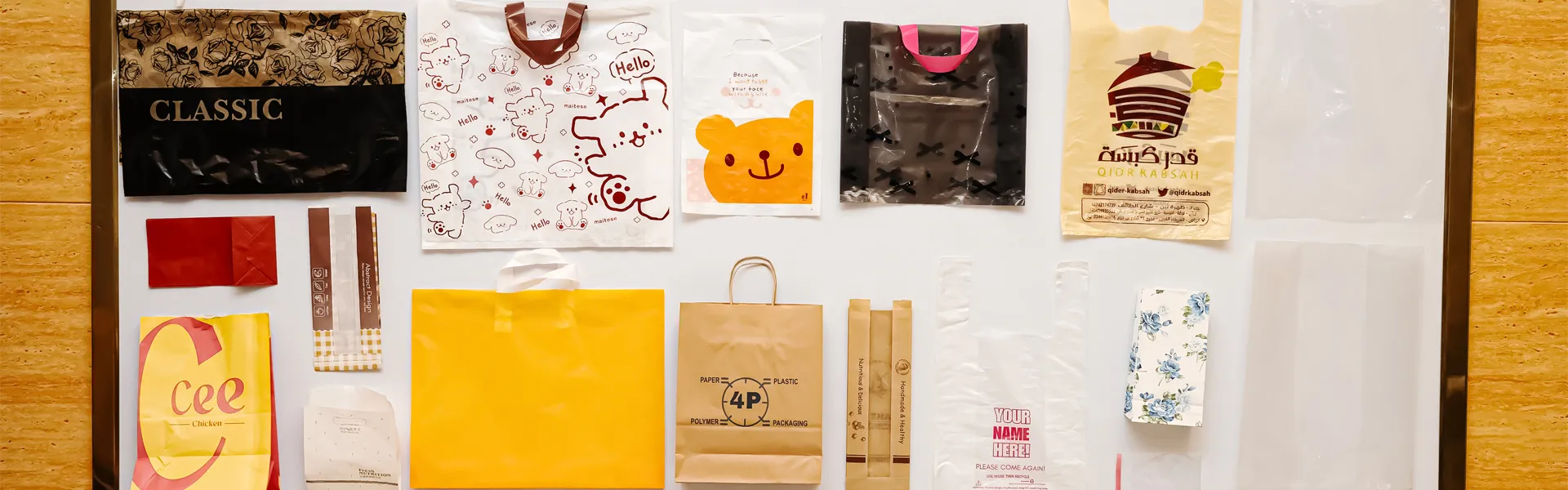
Walk into any supermarket, convenience store, or street market anywhere in the world, and the bag handed to you at checkout is almost certainly a T-shirt bag - the die-cut handle bag with the two curved cutouts at the top that give it its name. Behind every one of those bags is a machine that sealed, cut, stacked, and counted it in a matter of seconds. Understanding how that T-Shirt Plastic Bag Making Machine automates the entire process explains why this bag format dominates global retail packaging.
What Is a T-Shirt Bag and Why Does Automation Matter?
A T-shirt bag - also called a vest bag, singlet bag, or die-cut handle bag - is a polyethylene film bag with:
A bottom seal (or side seals on gusseted variants)
Two symmetrical curved cutouts at the top that form the carry handles
A closed top arch between the handles
The geometry is simple, but producing them at commercially viable volumes by hand is not. A mid-size retail operation might go through 50,000–200,000 bags per day. Automating the seal, cut, and stack sequence on a purpose-built machine is what makes per-bag costs of fractions of a cent economically achievable.
The Raw Material: Film Roll Configuration
T-Shirt Plastic Bag Making Machine Automate start with lay-flat polyethylene tubing wound on a roll. This is already a tube of film - two layers sealed at both edges - rather than a flat sheet. The tube diameter, when flattened, corresponds to the finished bag width plus a small margin.
Common film specifications:
| Parameter | Typical Range |
|---|---|
| Film material | HDPE, LLDPE, or blended |
| Roll width (lay-flat) | 200–800 mm |
| Film thickness | 10–30 microns (HDPE); 20–50 microns (LLDPE) |
| Roll weight | 50–200 kg per roll |
HDPE is by far the dominant material for T-shirt bags - it produces the characteristic crinkly, slightly opaque bag seen at most grocery checkouts. Its higher stiffness at lower gauge (thinner wall) is ideal for handle bags because the handle cutout needs to bear load without tearing. LLDPE or blended film is used where clarity or softness is more important than stiffness.
The tube comes off the roll through a film unwind and tension control system - dancer rollers and a braking mechanism on the roll shaft that keep film tension consistent regardless of the decreasing roll diameter as the roll depletes. Inconsistent tension is one of the primary causes of seal misalignment and handle-cut registration errors, so this stage is more critical than it appears.
Step 1 - Film Feeding and Registration
From the unwind station, the lay-flat tube travels through a series of guide rollers and spreader bars that keep the two layers flat, aligned, and wrinkle-free before entering the sealing station.
On machines with print registration capability, a photocell sensor reads printed marks on the film (called eye marks or registration marks) and synchronizes the seal and cut position to the printed artwork. This ensures that a pre-printed logo, brand name, or design lands in the correct position on each finished bag rather than drifting relative to the seal line.
For unprinted film, registration is based only on the machine's servo or stepper motor feed length setting. The film moves forward a fixed distance each cycle, and that distance is set by the desired bag length.
Step 2 - Bottom Seal Formation
The T-shirt bag's strength depends on the bottom seal. The machine makes this seal by pressing a heated sealing bar against the film for a set dwell time. The sealing bar has resistance heating elements inside it. A PID controller keeps the bar's temperature steady, usually between 120–200°C, depending on the film type and thickness.
The sealing bar on most T-Shirt Plastic Bag Making Machine Automate has a serrated or ribbed surface, not a flat face. The serrated shape does three things:
Increases the seal surface area
Creates a textured seal bead that resists peeling open under load
Helps handle small changes in film thickness across the web width
Seal quality parameters that operators can control:
Seal temperature - Higher temperature makes the bond stronger but can burn through thin film. Lower temperature may cause cold seals that peel open under load.
Dwell time - This is how long the sealing bar touches the film. It is usually 0.3–1.2 seconds, depending on film thickness.
Seal pressure - This is the air cylinder pressure on the sealing bar. It is usually 0.4–0.7 MPa.
On servo-driven machines, seal dwell time is precisely controlled by the servo motor's position profile. On older cam-driven machines, dwell is a function of the mechanical cam geometry and can only be adjusted by changing cam profiles - a significant maintenance task.
Step 3 - Perforation or Separation Cut
Immediately after the seal bar contacts the film to form the bottom seal, a cutting blade or hot wire integrated into or adjacent to the sealing bar separates the sealed bag from the continuous film web.
Two cutting mechanisms are common:
1. Hot Wire / Nichrome Wire Cut A thin resistance wire runs across the film width parallel to the sealing bar. When energized, it reaches cutting temperature nearly instantaneously and melts through the film. The cut edge is slightly fused, which can be a cosmetic disadvantage on clear film but provides a clean separation.
2. Cold Blade Cut with Serrated Edge A mechanical blade with a serrated edge punches through the film. This produces a cleaner edge appearance on printed film but requires periodic blade replacement and sharper attention to cut alignment.
On many T-shirt bag machines, the sealing bar and cutting element form an integrated assembly - the seal and cut operations happen in the same press stroke, reducing cycle time. The film is sealed on one side of the blade and the cut separates the just-sealed bag from the next bag's future bottom.
Step 4 - Handle Die Cutting (The Defining Operation)
This is the step that distinguishes a T-shirt bag machine from a simple bag-making machine. After the bottom seal is formed and the bag length is cut, the top of the bag - still attached to the film web at this stage in continuous machines, or already separated in step-and-repeat machines - passes under a handle die cutter.
The die cutter consists of:
A steel rule die - a custom-shaped cutting die with a blade profile that matches the two curved handle cutouts and the top arch of the bag
A cutting platen - a flat hardened surface that the die presses against to complete the cut through both film layers
A pneumatic or servo-actuated press mechanism that drives the die down at controlled force and speed
The die cutting process:
- The film (or separated bag) is positioned so the top of the bag is aligned under the die
- The press drives the die through both layers of the lay-flat tube simultaneously
- The two handle holes and the top arch cut-out are punched in a single press stroke
- The cut waste (the two small crescents of film from the handle holes, and the top arch piece) is collected and removed by a waste extraction system - typically a vacuum nozzle or waste-pull conveyor
Registration accuracy between the bottom seal line and the handle die cut position determines whether the handle opening is centered and at the correct distance from the top edge. On servo-controlled machines, this registration is maintained to ±1–2 mm across the production run. On cam-driven or less precise machines, drift of ±3–5 mm is common over long runs and requires periodic manual adjustment.
Step 5 - Stacking and Counting
Individual bags drop from the die cutting station onto a stacking conveyor or stacking pins. Most T-shirt bag machines use a pinned stacking system - two vertical metal pins positioned to pass through the handle holes of each bag as it falls, ensuring all bags in the stack are aligned with handles registered to the same position. This makes the finished stacks easy to load onto display racks or dispensers at retail checkouts.
Counting is handled by:
Optical sensor / photocell - detects each bag as it passes a fixed point in the film path or stacking area
Mechanical counter integrated with the main machine cycle counter
When the preset count is reached (commonly 50, 100, or 200 bags per stack depending on customer specification), the machine either:
Automatically ejects the completed stack to a collection tray and begins a new stack
Signals the operator to remove the stack manually
Higher-end machines include automatic stack ejection and conveyor transfer systems that allow continuous unattended operation, with completed stacks conveyed to a packing station.
Step 6 - Baling or Packing
While not always integrated into the machine itself, the downstream step on high-output lines is automatic baling - a compression system that squeezes a defined number of stacks into a compact bale and applies a strap or wrapper. T-shirt bags compress to very small volumes due to HDPE's stiffness and thin wall, so bale density is high. A typical bale of 1,000 HDPE T-shirt bags (standard grocery size, ~12 microns) weighs approximately 0.8–1.2 kg and occupies roughly 15–20 cm³ before compression.
Machine Speed and Output Rates
T-shirt bag machine output is measured in bags per minute (bpm). Practical production rates depend on bag size and film thickness:
| Bag Width (lay-flat) | Film Type | Typical Speed |
|---|---|---|
| 200–350 mm | HDPE 12–15 micron | 120–200 bpm |
| 350–500 mm | HDPE 15–20 micron | 80–140 bpm |
| 500–700 mm | HDPE/LLDPE 20–30 micron | 50–100 bpm |
Multi-lane configurations - where the film web is wide enough to produce two or more bags side-by-side - multiply effective output. A dual-lane machine running at 120 bpm per lane delivers 240 finished bags per minute from a single machine cycle, with two die cutters operating in parallel.
Control Systems and Automation Intelligence
Modern T-shirt bag machines are controlled by a PLC (Programmable Logic Controller) with a touchscreen HMI. Operators set and monitor:
- Film feed length (bag length)
- Seal temperature and dwell time
- Cutting blade pressure
- Bag count per stack
- Production speed (bpm)
Alarm thresholds for seal temperature deviation, film break, and jam detection
Servo motor systems on higher-spec machines replace older mechanical cam-and-crank designs. Servo drives allow:
Electronic adjustment of bag length without mechanical change parts
Faster and more repeatable positioning of the sealing bar and die cutter
Reduced mechanical wear and lower maintenance frequency
Real-time correction of registration drift without stopping the machine
Some machines incorporate automatic tension feedback loops - load cell sensors on the film path report tension values to the PLC, which adjusts the unwind brake in real time. This eliminates the need for manual tension re-adjustment as the roll depletes, a significant source of operator intervention on older designs.
Common Quality Issues and Their Machine-Level Causes
| Issue | Likely Machine Cause |
|---|---|
| Seal peeling open under load | Insufficient seal temperature or dwell time; contaminated seal bar surface |
| Handle cut off-center | Registration sensor drift; servo position error; worn guide rollers |
| Bags sticking together in stack | Excessive seal temperature causing film blocking; improper film cooling before stacking |
| Inconsistent bag length | Film tension variation; encoder slip; guide roller wear |
| Torn handles | Die blade dull or chipped; excessive die cutting force on thin film |
| Wavy seal line | Film wrinkles at entry to seal bar; spreader bar misalignment |
fAQ:
What is the difference between a T-shirt bag machine and a flat bag-making machine? A flat bag machine produces plain rectangular bags with no handle cutout. A T-shirt bag machine adds a die cutting station with a custom handle die that punches the curved handle openings. Flat bag machines are mechanically simpler and typically run at higher speeds; T-shirt bag machines require handle die changeover when switching to different bag sizes.
Can a T-shirt bag machine run LDPE or LLDPE film as well as HDPE? Yes, most machines are compatible with all three, but the seal temperature and dwell time settings differ significantly. LDPE and LLDPE have lower melting points and require lower seal temperatures. Operators must update settings when switching materials, and the handle die cutting force may need adjustment because LDPE/LLDPE films stretch more than HDPE under the die blade.
How often does the handle die need to be replaced? Steel rule dies on standard HDPE film typically last 3–8 million cycles before the blade dulls enough to cause torn or ragged handle edges. The life range is wide because it depends on film thickness, die steel grade, and cutting force settings. Many operations keep a spare die per size to enable quick changeover when the running die is sent for resharpening.
What causes the handles to tear during use rather than during production? In-use handle tear is usually a film selection or gauge issue rather than a machine issue. HDPE below 12 microns is prone to handle tear under moderate load, particularly if the handle die leaves a stress concentration at the cut edge radius. Increasing film gauge to 14–16 microns, switching to an LLDPE blend, or adjusting the handle cutout geometry (larger radius at the base of the handle arch) are the standard solutions.
What is a multi-lane T-shirt bag machine and when does it make sense? A multi-lane machine runs a wider film web and produces two or more bags per machine cycle using two or more sets of sealing bars and die cutters in parallel lanes. It makes economic sense when the required bag width is small relative to available film roll widths, allowing the film cost per bag to be split across lanes. For bags under 350 mm wide, dual-lane configurations are common; for bags under 250 mm, quad-lane machines exist.
The T-shirt bag machine's automation logic is essentially a tight sequence of film advance, seal, cut, handle punch, and stack - repeated hundreds of times per minute with servo precision. Each step in that sequence is engineered to minimize dwell time, reduce registration error, and handle the mechanical fragility of thin polyethylene film without tearing or misfeeding. That combination of speed and precision is what keeps the per-unit cost of a T-shirt bag below the cost of the product it carries.


