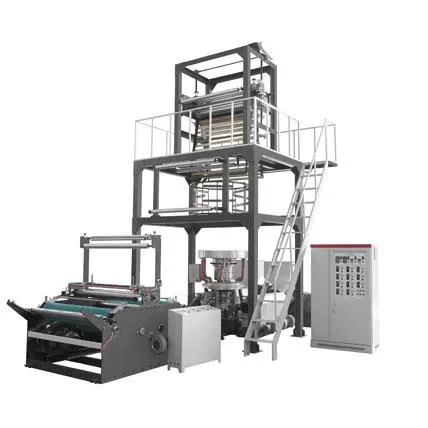
In the realm of plastic film production, ABA three-layer extrusion blowing membrane method has become a mainstream technology with its superior product performance and wide range of applications. As the core module of blown film machines, membrane bubble cooling system directly influences film crystallinity, thickness uniformity and production speed. At present, due to the insufficient cooling efficiency, the industry generally faces production bottlenecks. This paper systematically discusses technical ways to improve the output of ABA film bubble cooling system from four aspects: cooling system design, process parameter optimization, intelligent control and maintenance management.
1.Innovative design of Cooling System Structures
1.1 Conformal Cooling Channels and Zonal Cooling Technology
Traditional cooling channels are mainly linear or helical, and there are some problems such as cooling blind area and temperature gradients. The conformal cooling channels is manufactured by using 3D printing technology, which can be aligned with the film bubble contour. Using the technology, a consumer electronics company reduced the cooling time of a polycarbonate (PC) handle component from 18 seconds to 12 seconds, shortening the molding cycle by 33%. For ABA blower, conformal cooling channels can be achieved in key areas of the die head, such as the melt distributor and mold lip, in combination with a zoning cooling strategy. Separate channel densities can be set for areas with large variations in wall thickness variations, such as between the core and surface layers layers. For example, doubling the channel density in thick-walled core areas can reduce cooling time by 40% and significantly improve overall cooling efficiency.
1.2 Heat Pipe Cooling and Phase Change Heat Transfer Enhancement
In elongated mandrels or hot zones (such as inside a melt distributor), embedded heat pipes can be cooled effectively using phase transition heat transfer characteristics. A manufacturer of air filters for cars has reduced the cooling time of its cores from 25 seconds to 15 seconds, with a 60 percent reduction in product warp, after integrating heat pipe technology. For ABA film bubble systems, heat pipe arrays can be strategically placed at a key heat source within the die head to rapidly output heat utilizing evaporation-condensation cycle. In addition, local enhanced cooling using liquid carbon dioxide can target heat spots that are difficult to reach in traditional water channels (e.g., die head joints). The adoption of the technology by A reflector mold manufacturer resulted in a 45% reduction in cooling time and a reduction in annual water consumption of 2,000 tons.
1.3 Low-Temperature Differential Cooling Medium Circulation Systems
The temperature fluctuation of cooling water will cause the film to contract unevenly and cause thickness deviations. By installing mold temperature, the temperature differential between cooling water inlet and mold can be maintained below 5 ℃. The precision mold manufacturer reduced the temperature fluctuation of the cooling water from ±3°C to + -0.5°C with this technology, resulting in a 0.02 mm increase in product size accuracy. For ABA system, PID-controlled plate heat exchanger combined with closed-loop cooling tower is recommended to achieve accurate cooling water temperature regulation. Online water quality monitoring systems should also be integrated to prevent scaling-induced heat transfer efficiency degradation.
2. Dynamic Optimization of Process Parameters
2.1 Synergistic Control of drumming and pumping ratios
Blowout ratio (BR) and blow out ratio (DR) are the key process parameters that affect film bubble cooling efficiency. Excessive BR causes film bubble to overstretch and increase cooling load, while insufficient DR causes membrane vesicles to relax and prolong cooling time. A 3-D response surface model of BR-DR-cooling time is established by CAE simulation. For example, one company optimized the production of low-density polyethylene films, adjusting BR from 2.5 to 2.2 and DR from 4.0 to 3.5, shortening cooling times by 15% and increasing daily production by 12% while maintaining bubble stability.
2.2 Gradient Design of Temperature Profiles
temperature gradient comprises melt temperature, die head temperature and cool air temperature. For an ABA three-tier structure, distinct temperature profiles must be set for the surface layers (A layer), core layer (B layer) and bottom layer (A layer). The surface temperature distribution of membrane bubble was monitored by infrared thermography, and the crystallization of membrane bubble was analyzed by (Differential Scanning Calorimetry. After applying the model, one company reduced melt temperature from 220°C to 210°C and adjusted the die head temperature gradient from 180 °200 °180°C to 175 ° -195175°C, shortening cooling time by 12% while maintaining the mechanical properties of the film.
2.3 Optimization of the flow field of cooled air rings
Traditional air ring single annular outlets, and the air flow is not evenly distributed. By calculating hydrodynamic simulation to optimize air ring structure, a combination of a multi-stage deflector and adjustable angle nozzle is used to achieve uniform cooling air volume. One company adjusted the outlet angle of the wind ring from 30° to 25°, increased air velocity from 3.5 m/s to 4.2 m/s, reduced the surface temperature differentials the film bubble from ±1.5°C to + -0.8°C, and enhanced refrigeration efficiency by 20%. In addition, by introducing pulse cooling technology, the air pressure changes periodically, destroying the surface boundary layer of the film bubble, which can further strengthen convective heat transfer.
3. Intelligent monitoring and Predictive Maintenance
3.1 Multi-Sensor Fusion Monitoring Systems
By deploying temperature, pressure and flow sensor arrays, data can be obtained in real time from key nodes such as die heads, water channels and air rings. Edge computing nodes facilitate data preprocessing, while machine learning algorithms build equipment health assessment models. A company that implemented the system predicted a cooling water pump failures 48 hours in advance, averting a production losses caused by an unexpected outage. For ABA system, it is suggested that the on-line film bubble diameter measurement module should be combined with visual inspection systems to monitor bubble shape in real time. process parameter adjustments can be triggered automatically when diameter deviations exceeds ±1%.
3.2 Digital Twin-Driven Process Optimization
The digital twin model of ABA blower is set up, the equipment physical parameters, process data and environment variables are integrated, virtual debugging is realized, and the control strategy of cooling system is optimized. One company used digital twin technology to simulate the change of film bubble morphology under different cooling water flows, reducing actual debugging cycles from 72 hours to 8 hours and reducing trial and error cost by 80%. In addition, digital twin model allows for a pre-evaluation of equipment upgrade scenarios (e.g., replacing heat pipes with efficient alternatives) and an assessment of potential enhancements in production output.
3.3 Predictive Maintenance Strategies
The early detection of faults can be achieved by establishing life prediction models for key cooling system components (e.g., water pumps, heat exchangers, gas ring motors) and combining vibration analysis with oil condition monitoring. One company used this strategy to reduce the cost of spare parts parts inventory costs 35 35% increasing the lead time between failures of cooling water pumps from 4,000 to 6,500 hours. For ABA systems, a layered maintenance plan is recommended: daily checks of cooling water flow and pressure, weekly cleaning of air ring filters, monthly heat pipe heat transfer efficiency tests, and annual canal chemical cleaning.
4. Ways Enhance System Energy Efficiency
Optimization of Cooling Medium Energy Efficiency in Cooling
The cooling water with low temperature difference (inlet temperature differential and mold ≤ 3 ℃) can reduce cooling tower load. By doing so, one company has reduced chiller energy consumption of its chillers by 18%. For high-temperature processes (e.g., PP film production), oil cooling systems can be considered as an alternative to water cooling. One auto components maker saw a 25% increase in cooling efficiency and a 25% percent reduction in unit production energy consumption after switching to 12 cooling. In addition, the energy energy consumption can be further reduced by integrating heat recovery device and utilizing the waste heat of cooling water to preheat the raw materials.
4.2 Variable Frequency Drives and Intelligent Control
The energy-consuming components such as cooling water pumps and fan are regulated by frequency conversion, which can be speed adjustment dynamically according to actual load. One company used frequency conversion technology to reduce cooling system energy consumption by 30% while minimizing downtime caused by mechanical wear. Artificial intelligence algorithms that Combining adaptive cooling parameters, such as automatically calibrating cooling water flow setpoints based on changes in ambient temperature, enabled the company to reduce summer output fluctuations from ±8% to ±3%.
4.3 Lightweight Die Design
Topology optimization reduces die head quality and cooling system load. By reducing the weight of the die from 120kg to 95kg, the company has reduced cooling time of the motor by 10% while shortening the energy consumption of the motor. For ABA systems, it is recommended to use high thermal conductivity alloys (such as copper andaluminum alloys) as key die head components and to apply surface nano-polishing to improve heat transfer efficiency. Experimental studies have shown that these techniques can shorten cooling time by 15-20%.
Conclusion:
Optimizing ABA film bubble cooling systems is a multidisciplinary systems engineering endeavor requires coordinated advancement in structural design, process control, intelligent maintenance, and energy efficiency management. By introducing innovative technologies such as conformal cooling channels and heat pipe cooling, combining digital twin algorithm and artificial intelligence algorithm to optimize dynamic process parameters, the cooling efficiency and membrane quality can be significantly improved. At the same time, the establishment of predictive maintenance system and energy efficiency management platform, further reduce the risk of unplanned downtime and operating costs. Looking ahead, breakthroughs in cutting-edge technologies such as liquid metal cooling and supercritical CO2 cooling will continue to push ABA blower production limits and provide technical support for high-quality growth in the plastics industry.